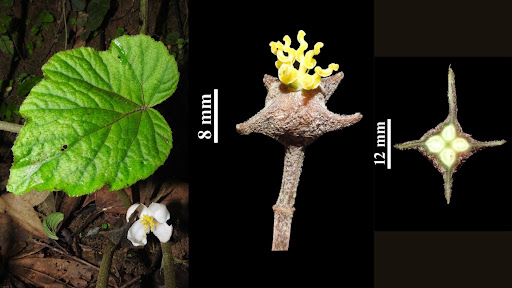
Botanists have discovered a new plant species in the remote forests of northeast India, characterised by its four-horned fruit and vibrant, bristly red-brown hairs. The new species, named Begonia quadricornualata, was identified by a team of researchers from the Botanical Survey of India (BSI) in the Papum Pare district of Arunachal Pradesh. This region, nestled at the intersection of the Himalaya and Indo-Burma biodiversity hotspots, remains a treasure trove for scientists, with this latest find bringing the number of Begonia species in the state to 50.
The discovery occurred during a routine botanical documentation project in Senki View, located on the eastern fringe of the Itanagar Wildlife Sanctuary. While trekking through the moist soil near forest streams, the researchers, Rohan Maity, Umeshkumar L. Tiwari, and Sudhansu Sekhar Dash, encountered a unique population of plants with upright stems and delicate white-to-pink flowers. After a morphological study and comparisons with existing records, the team confirmed that the plant was new to science.
What sets Begonia quadricornualata apart from its closest relatives is its distinctively rugged appearance. The female plants are covered in dense, long, red-to-brown "hispid" hairs, stiff bristles that give the leaves a woolly texture. It also boasts exceptionally long leaf stalks, or petioles, which can reach up to 50 centimetres in length, nearly double the size of its nearest cousins, Begonia handelii and Begonia tessaricarpa. While its relatives often grow flowers in clusters, the female version of this new species produces only a single flower at a time.
The name of the new species is a literal description of its most unusual physical trait. Derived from the Latin words quattuor (four), cornu (horn), and alatus (winged), the name quadricornualata refers to the way four horns on the plant’s ovary transform into four fully developed wings as the fruit matures. This unique fruit structure, which is densely covered in reddish-brown wool, helps distinguish it from other hornless or ridged species in the region.
Despite the excitement of the discovery, the future of the four-horned begonia is precarious. During their monitoring from 2019 to 2025, researchers found only two small subpopulations consisting of approximately 11 mature individuals. The habitat is currently under pressure from human activities, including road expansion, livestock grazing, and the spread of invasive weeds. For now, the species has been categorised as "Data Deficient," as scientists hope to find more populations hidden deeper in the subtropical forests of the Eastern Himalayas.