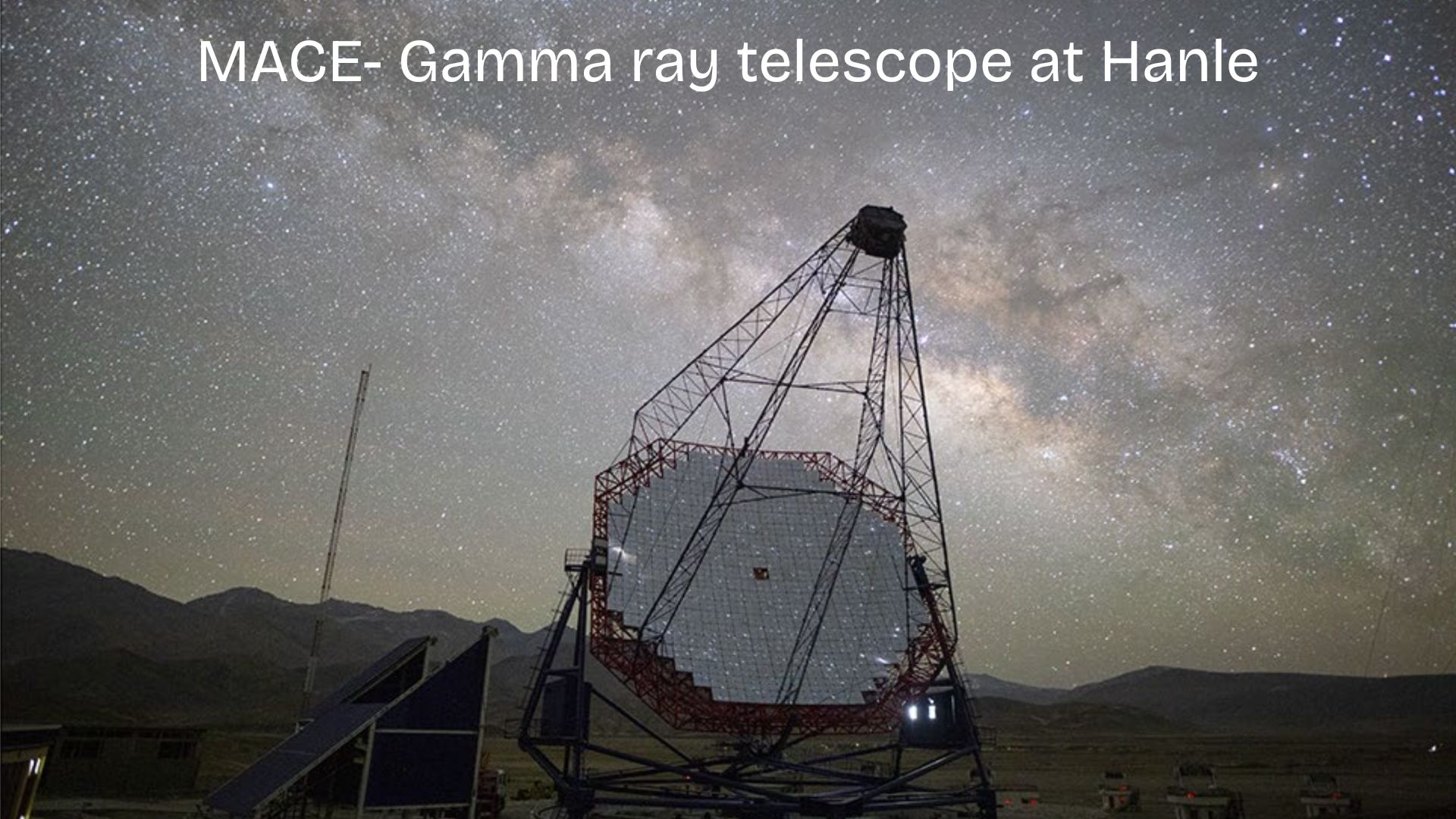
High in the Himalayan desert of Hanle in Ladakh sits Asia's largest and the world's third-largest gamma-ray telescope, the Major Atmospheric Cherenkov Experiment, or MACE, opening a new window into the universe's most violent events. Situated at an altitude of roughly 4.3 kilometres, this state-of-the-art facility is designed to detect very high-energy gamma rays emitted by extreme cosmic phenomena, ranging from supermassive black holes at the centres of distant galaxies to the mysterious dark matter that holds the universe together. K K Singh from the Bhabha Atomic Research Centre provides an overview of how the telescope is advancing our understanding of the cosmos by detecting high-energy signals from the furthest reaches of space.
When high-energy gamma rays from the far reaches of space strike the Earth's atmosphere, they do not make it to the ground. Instead, they crash into air molecules, triggering a massive cascade of secondary subatomic particles that rain down toward the surface. Because these secondary particles are moving faster than the speed of light in the air, they produce a microscopic, fleeting optical equivalent of a sonic boom. This phenomenon creates incredibly faint, billionth-of-a-second flashes of blue light known as Cherenkov radiation. MACE reflects and focuses these rapid blue flashes onto a high-speed camera, effectively turning Earth's atmosphere into a giant tracking chamber.
To do this, MACE is equipped with an enormous 21-metre dish composed of 1,424 highly polished metallic mirror panels. The high-speed camera contains over a thousand ultra-sensitive light detectors, allowing it to capture the shape and intensity of Cherenkov flashes. Working backwards, researchers can then determine the exact energy and origin of the original gamma ray.
Researchers have already used MACE to make some fascinating discoveries. They have captured giant flaring episodes from the radio galaxy NGC 1275, successfully measuring how relativistic electrons in the galaxy's jet scatter light up to terrifyingly high energies. In a major breakthrough, the telescope also detected a strong gamma-ray signal from a blazar, a type of galaxy with a supermassive black hole firing a jet directly at Earth. The galaxy is located at an astonishingly high redshift, meaning its light has been stretched over the long distances it had to travel to reach us. This discovery pushes the boundaries of how far back in space and time such ground-based instruments can see.
Beyond distant black holes, researchers are using MACE to study pulsars, the incredibly dense, spinning remnants of dead stars. Currently, only five pulsars worldwide have been detected by ground-based gamma-ray telescopes, and MACE's unique sensitivity positions it perfectly to find more. Furthermore, the telescope is staring deep into dwarf galaxies like Segue 1 and Draco, hoping to catch the elusive gamma-ray signatures produced when invisible dark matter particles collide and annihilate each other.
The MACE telescope is the successor to India's first-generation atmospheric Cherenkov Imaging telescope, TACTIC, which has been operating for over two decades. Due to its massive light-collecting area and improved electronics, MACE can detect gamma rays at much lower energy thresholds, down to about 20 gigaelectronvolts, a range previously difficult to study from the ground. Its geographic location in Ladakh is also a strategic triumph for global astronomy, filling a crucial longitudinal gap between telescopes in the Americas and Europe. This ensures that, when transient, highly energetic cosmic flares occur, the global scientific community can monitor them continuously as the Earth rotates.
Despite these incredible advancements, the telescope's current setup still has certain limitations. Because MACE is currently operating as a single, or mono, telescope, it is inherently limited in sensitivity and struggles to achieve the pinpoint angular and energy resolutions of setups that use multiple telescopes simultaneously. To overcome this hurdle, researchers have already proposed upgrading the facility into a stereoscopic system by building identical telescopes nearby. By simultaneously viewing the same atmospheric particle cascades from multiple angles, this future array will provide a sharper, three-dimensional view of the extreme universe.
The drive to build this world-class facility indigenously has spurred massive technological leaps in local industries, resulting in lucrative spin-offs in the manufacturing of large-scale aspheric metallic mirrors, advanced semiconductor photo-detectors, and high-speed data-processing electronics. Beyond the engineering and technological triumphs, the presence of the telescope is also transforming the remote region of Hanle into a global hub for frontline astronomical research. It is creating high-quality jobs, fostering educational opportunities, and driving a booming astro-tourism industry that is boosting economic growth for local communities.
The MACE telescope has already proven to be a monumental asset, firmly positioning India at the vanguard of global high-energy astrophysics, while spurring vital technological spin-offs in advanced optics and boosting Ladakh's local economy. Looking to the future, MACE will serve as the cornerstone for an even more ambitious multi-telescope observatory. As the facility expands to incorporate cutting-edge dual-mirror technologies and next-generation semiconductor detectors, it will deepen our fundamental understanding of the universe's most profound mysteries, from dark matter to supermassive black holes. More importantly, it will also continue to drive domestic engineering innovation and inspire the next generation of scientific discovery.