A new four-year atmospheric study has indicated a deterioration in the air quality of Bengaluru, showing that the city’s rapid transformation into India's premier tech hub has come at a steep environmental and public health cost. This research has been led by Dhanya G. and a team of researchers from the National Institute of Advanced Studies (NIAS), Bangalore University, and the Indian Institute of Tropical Meteorology (IITM). Their comprehensive investigation tracked carbon monoxide (CO) and black carbon (BC) levels from January 2015 to December 2018.
Published in Theoretical and Applied Climatology, the data reveal that as Bengaluru’s vehicular population grew exponentially, everyday traffic emissions became the primary drivers of toxic air pollution. Notably, the researchers discovered that the city's unique weather patterns and a shifting atmospheric “ceiling” act as invisible hands, either trapping these harmful pollutants at breathing level or washing them away, leaving the population vulnerable to serious cardiovascular risks like heart disease.
To understand how Bengaluru's air turned toxic, one must look at its explosive growth. Once celebrated across India as the breezy, green “Garden City,” Bengaluru is now the country’s third most populated megacity, home to over 13.5 million people. This tech-driven economic boom has triggered a staggering 10.6% annual growth rate in vehicle registrations over the past few decades. By 2016, the city had reached a density of 600 vehicles for every 1,000 people, a registration rate more than double that of New Delhi! This relentless surge in personalised transit has replaced the city's flora and water bodies with concrete and asphalt, triggering an artificial localised temperature spike of up to 2.5 degrees Celsius.
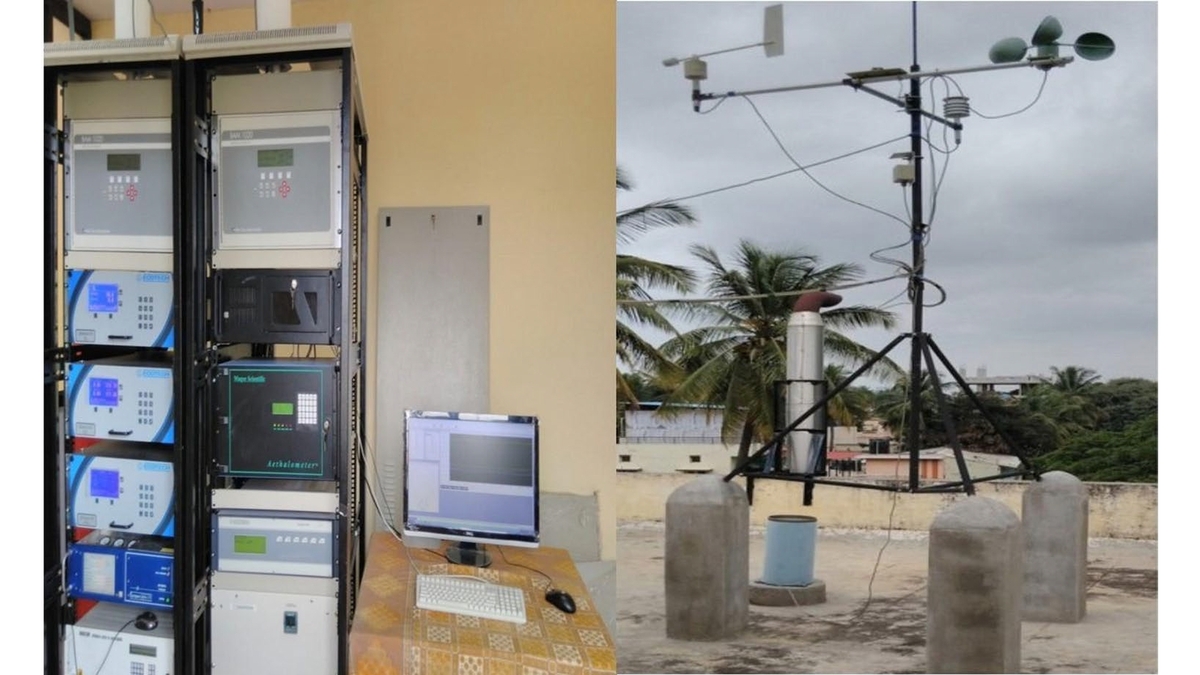
The researchers set up a state-of-the-art monitoring station on the rooftop of the BMS College of Engineering. For four continuous years, sophisticated optical and infrared sensors sniffed out the signature of incomplete fuel combustion: carbon monoxide gas and microscopic, light-absorbing soot particles known as black carbon.
The results were striking. Over the study period, the average concentration of carbon monoxide stood at 0.84 parts per million by volume (ppmv), but it frequently spiked as high as 4.07 ppmv. Meanwhile, black carbon averaged 3.28 micrograms per cubic meter (µg/m3), peaking at a worrying 9.5 µg/m3. Alarmingly, over the four years, carbon monoxide concentrations suffered a substantial net rise of roughly 52%, underscoring the compounding weight of emissions from the expanding vehicle fleet.
What makes this study unique is how it unmasks the daily, rhythmic heartbeat of the city’s atmosphere. Using advanced statistical analysis, the team identified a distinct bimodal or double-peak pattern in pollution levels every single day. The first peak strikes in the morning between 7:00 AM and 11:00 AM, and the second arrives in the evening between 7:00 PM and 9:00 PM. This pattern maps perfectly onto Bengaluru’s notorious rush-hour traffic.
However, it appears that the city residents are not just fighting traffic. In reality, they are experiencing the effects of a planetary boundary layer, the lowest part of the Earth's atmosphere that behaves like a giant, dynamic room. During the day, solar heating warms the Earth, causing this atmospheric room to expand and push its ceiling high into the sky. This allows vehicular exhaust to mix thoroughly and dissipate, resulting in lower pollution levels during the afternoon. However, as night falls and temperatures drop, the boundary layer collapses, bringing the ceiling crashing down close to the ground. When evening rush-hour traffic pumps fresh exhaust into this constrained space, the exhaust has nowhere to go, creating a highly concentrated bowl of pollution that lingers into the night.
The seasons bring their own dramatic twists to this atmospheric drama. The researchers noted that pollution levels peaked dramatically during the dry winter and summer months. In winter, cold temperatures naturally preserve a low atmospheric ceiling, locking pollutants right at the surface where people breathe. Conversely, the wet summer monsoon season acts as a saviour for the city. As heavy downpours sweep across southern India, they trigger a natural scrubbing mechanism called rain scavenging. The rainfall literally washes the black carbon soot out of the sky, while strong south-westerly winds mix the air thoroughly, dropping carbon monoxide to its lowest yearly levels. This weather-dependent cleansing explains why black carbon levels actually dipped slightly during the unusually rainy years of 2017 and 2018, even as carbon monoxide emissions from traffic continued to climb.
This research significantly improves upon older air quality studies in southern India, which were traditionally limited to short, episodic observations spanning only a few weeks or months. By collecting four full years of continuous, high-resolution data, the researchers have established a reliable baseline that accounts for long-term seasonal and inter-annual anomalies. Furthermore, rather than just measuring raw numbers, this study successfully paired real-world chemical tracking with satellite-derived data of the planetary boundary layer, providing a definitive look at the physics governing urban pollution. It also stands out by translating atmospheric chemistry directly into human terms through the utilisation of specialised World Health Organisation software to project long-term public health impacts.
However, the study carries some limitations. Because the data was collected from a single, high-altitude monitoring station located on a college rooftop in south Bengaluru, it may not perfectly capture the extreme, localised ground-level exposures felt by commuters trapped at street-level bottlenecks, nor does it account for variations in heavily industrial zones in north or east Bengaluru. Additionally, while the study used advanced statistical modelling to pinpoint traffic as the primary culprit, it lacked the chemical tracer technology needed to precisely isolate the specific shares of pollution caused by diesel vehicles, biomass burning, or widespread residential diesel generators.
By deploying the WHO AirQ+ model, the study mathematically proved a direct link between long-term black carbon exposure and heightened mortality from ischemic heart disease among Bengaluru's residents. These findings remove air pollution from the realm of abstract environmentalism and place it firmly in the domain of public health emergencies.
Today, urban administrators, planners and environmental policymakers can use these precise bimodal traffic and boundary layer insights to design smarter interventions. For example, the findings validate the urgent need to expand electric public transit, enforce stricter low-emission zones during evening hours when the atmosphere traps toxins, and expand green corridors to reverse the urban heat island effect. By showing exactly when and why the air becomes dangerous, this study provides the critical data needed to transition Bengaluru from a congested tech hub back into a liveable, healthy Garden City.