An international team of scientists has mapped out how three of the world’s largest emerging economies, Brazil, India, and Indonesia, can drastically cut their greenhouse gas emissions by 2050, by transforming how they manage their land. The study shows that the agriculture, forestry, and other land-use sector is the key to achieving decarbonization in these nations. Because these three countries are currently among the highest global emitters in this sector, they also hold the greatest potential for climate mitigation. The researchers found that the vast majority of these emission cuts will not come from changing what people eat, but rather from changing how forests are protected and how soil is farmed. The team included researchers from Institut du Développement Durable et Relations Internationales (IDDRI.org), France; Indian Institute of Management (IIM) Ahmedabad; Bogor Agricultural University, Indonesia; Birla Institute of Technology and Science-Goa Campus; Federal University of Rio de Janeiro (UFRJ), Brazil; International Institute of Applied Systems Analysis (IIASA), Austria; and National Institute for Environmental Studies, Japan.
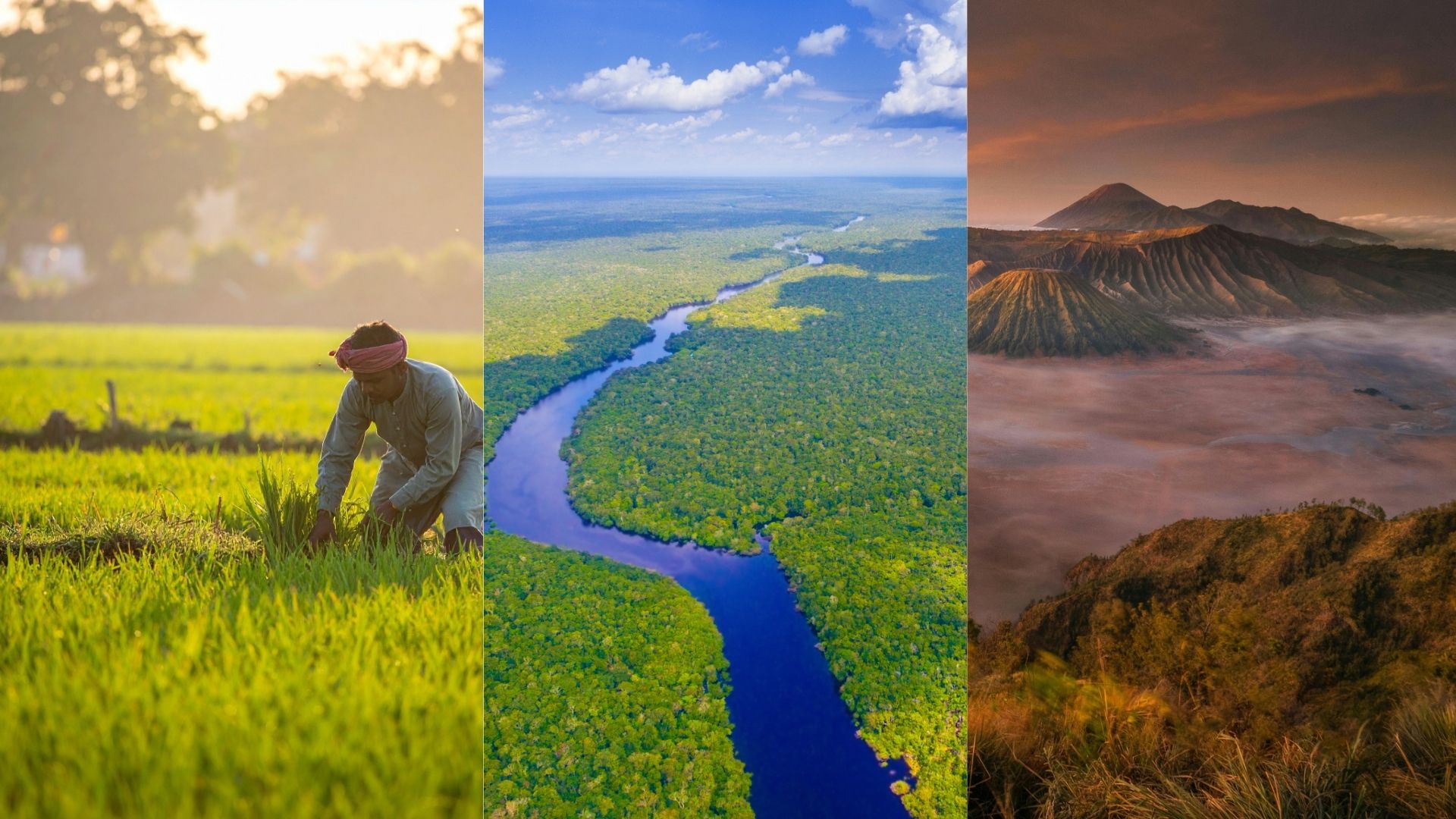
Carbon sinks are natural environments like forests and soils that absorb more carbon from the atmosphere than they release. The researchers identified that the most significant driver of climate mitigation in these nations lies in the land-use, land-use change, and forestry subsector. In Brazil, the strategy relies heavily on rapidly halting deforestation and expanding plantation forests. In Indonesia, the massive carbon savings will come from stopping the degradation of carbon-rich peatlands and preventing forest fires. Meanwhile, in India, the focus shifts to the ground itself, where increasing carbon storage in agricultural soils and planting trees on farmland will soak up millions of tonnes of emissions. In addition to acting as carbon sponges, the land in Brazil and Indonesia will increasingly be used to grow biomass, which is plant material that can be converted into renewable bioenergy to replace fossil fuels.
The researchers used environmental data to create a decarbonization pathway framework, constructing highly detailed, country-specific computer models. Teams of local experts in each nation fed local economic, agricultural, and dietary data into these programs. The software then simulated how different policy choices would affect everything from crop yields to national energy demands over the next thirty years. By linking agricultural models with wider economic simulations, the researchers could see how planting a new forest or changing a fertiliser policy would ripple through the entire national economy.
The study shows that transforming land use and forestry, specifically by halting deforestation, protecting peatlands, and storing carbon in agricultural soils, is the primary way for Brazil, India, and Indonesia to drastically cut greenhouse gas emissions by 2050. Because strict cuts to agricultural emissions risk harming food security and rural livelihoods, they concluded that climate strategies in these developing nations must focus on protecting nature and improving crop efficiency rather than changing dietary habits or reducing food production.
However, the researchers noted that their computer models struggled to accurately predict how future climate change events, such as worsening droughts, heatwaves, and unpredictable rainfall, might damage crop yields. Because the impacts of extreme weather are highly variable and difficult to model in economic software, the study had to assume relatively stable, ambitious increases in crop production. Furthermore, the models did not mathematically calculate the complex ripple effects these land changes will have on local biodiversity, nor did they calculate the exact number of farming jobs gained or lost.
Despite this, by integrating farm and forest data into comprehensive, economy-wide models, this new research ensures that the proposed climate solutions actually work in the real world without accidentally triggering economic crises or food shortages. By highlighting the trade-offs between economic development and achieving sustainable development goals, the research provides policymakers with a realistic guide to saving the environment. It proves that governments can successfully fight global warming while still ensuring that growing populations have enough food to eat and that rural farmers can maintain decent, thriving livelihoods.