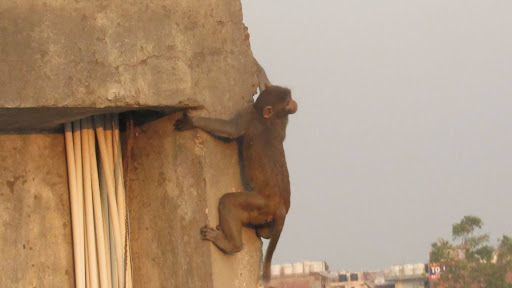
Researchers from the Zoological Survey of India have discovered that the familiar Indian rhesus macaque, commonly seen darting through cities and forests across the country, actually consists of two genetically distinct groups. By analysing DNA extracted from wild monkey droppings collected across twelve Indian states between 2020 and 2022, the researchers uncovered a genetic divide separating northern and eastern populations. This striking difference strongly suggests the presence of two separate subspecies of the rhesus macaque living in India.
The research team observed troops of macaques in their natural habitats and collected fresh faecal samples left behind once the monkeys moved on. At the laboratory, the scientists extracted DNA from these droppings. Specifically, they focused on mitochondrial DNA, a type of genetic material passed down exclusively from mothers to their offspring. By examining a specific region of this DNA, the researchers could identify genetic variations known as haplotypes, which provide unique genetic signatures for each species. When they mapped out the haplotypes, the data split neatly into two distinct family trees.
The first was a North Indian cluster stretching from the Himalayas down to central India, and the second was an East Indian cluster covering states like Odisha, Manipur, and the Sundarbans. Interestingly, this genetic split matches physical differences observed in the wild. Northern macaques are generally larger, more aggressive, and have yellowish-grey fur, while their eastern cousins are smaller, less aggressive, and sport darker brown coats. The team even found a genetic mixing zone in the southern state of Telangana, where monkeys carried DNA from both lineages, likely a result of recent human-made bridges and dams allowing the monkeys to cross ancient natural river barriers.
The genetic evidence also revealed a fascinating history of how these monkeys survived over millennia. By looking at the accumulation of minor genetic mutations, the scientists discovered that these macaques experienced a severe historical population drop before expanding rapidly in recent years. The recent expansion is largely attributed to their clever ability to adapt to human-dominated landscapes.
In the past, scientists mostly relied on samples taken from captive macaques, which led them to mistakenly believe that Indian rhesus macaques had very low genetic diversity and little geographical structure. While earlier researchers suspected that there might be two subspecies in the region, they did not have the field data to prove where these different monkeys actually lived. By sampling wild populations extensively across the country, the current research paints a much more accurate and vibrant picture of their distribution, revealing unexpected pockets of high genetic diversity and complex ancient migration routes from neighbouring countries like Myanmar.
The scientists, however, caution that there is a limit to what mitochondrial DNA alone can tell us. Because this type of DNA only traces the maternal line, it only tells half of the evolutionary story. The researchers note that to officially declare these two groups as distinct subspecies, future studies will need to analyse nuclear DNA, which is inherited from both parents, to confirm the taxonomic split.
By identifying the genetic divides, such as those found in the Indian rhesus macaques, biologists can accurately track how species have adapted to ancient climate shifts, geological changes, and geographical barriers over millions of years. Moreover, the study provides the knowledge needed to protect the complex web of biodiversity, ensuring that we preserve the distinct evolutionary histories and long-term resilience of our planet's ecosystems.