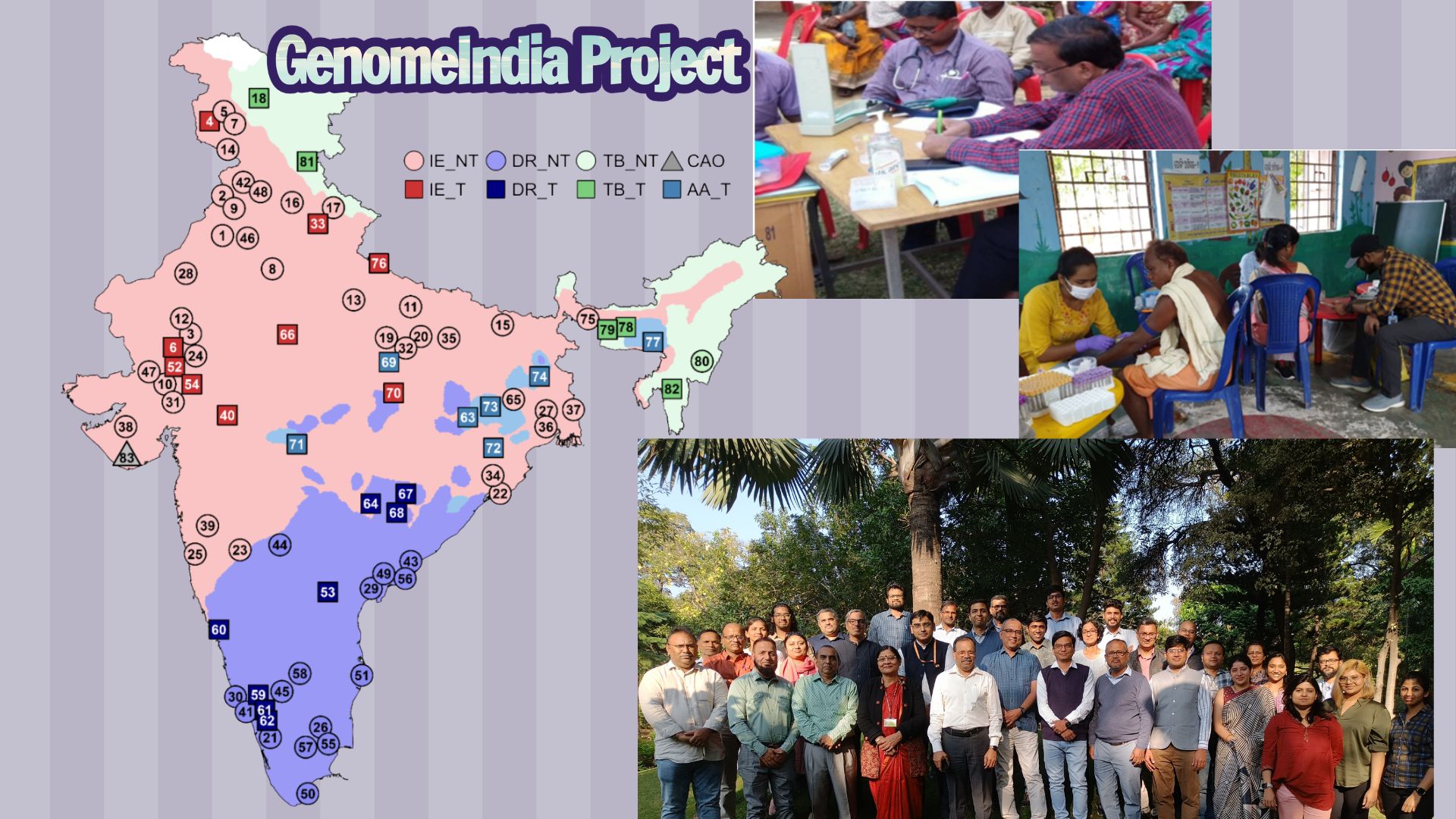
Researchers from the Genome India Consortium, which includes 20 universities, have used data from the GenomeIndia Project to discover over 44 million entirely new genetic variations. Their new study highlights unique genetic risks faced by the Indian population and clears a path for life-saving, customised medical treatments for a quarter of the world's population.
Despite being the world’s most populous nation, global genetic databases, which are repositories storing DNA sequences, genetic variants, or gene-related information of individuals, have been heavily dominated by populations of European descent. This has left many regions of the world, including India, vastly underrepresented. This massive blind spot has meant that modern genetic medicine often does not work as well for South Asians and other ethnicities.
To address this, the GenomeIndia project was launched in 2021, funded by the Department of Biotechnology, Government of India. The goal was to sequence the whole genomes of 10,000 individuals from 83 diverse Indian populations, providing valuable data for researchers. Researchers from medical institutions across India travelled the country to collect blood samples from participants representing a vast array of languages, geographies, and social structures, including both tribal and non-tribal groups. Back in the laboratory, the scientists used whole-genome sequencing to determine each person's genetic code. In 2025, the project achieved its goal, having collected more than 20,000 samples and sequenced more than 10,000 genomes.
In the new study, the researchers compared these sequences to existing global databases to identify variations in the DNA sequence. They identified over 129 million high-confidence genetic variants. Strikingly, 44.03 million of these variants were entirely novel and had not been reported in global genetic databases. The high number highlights a massive gap in existing genomic data.
The analysis revealed that genetic diversity is deeply tied to India’s unique history and cultural practices. The researchers found that endogamy, the centuries-old practice of marrying strictly within one's own community, has created distinct, isolated genetic groups. Over generations, this isolation led to certain globally rare genetic variants becoming common within specific local populations, a phenomenon known as the founder effect.
While large, non-tribal populations showed sustained population growth and genetic mixing, many isolated tribal groups exhibited persistently low effective population sizes, significant genetic drift, and strong founder effects. Long-term endogamy also causes these groups to exhibit extreme levels of homozygosity, in which an offspring inherits identical genetic traits from both parents. The phenomenon sometimes surpasses even the most well-studied isolated populations in the world, such as Ashkenazi Jews or the Finnish.
Because of endogamy and isolation, many harmful and loss-of-function genetic variants that are exceptionally rare globally have become highly concentrated in specific Indian communities. The researchers identified numerous localised variants linked to conditions such as macular degeneration, hearing loss, cardiomyopathy, and lipid-metabolism disorders. This means genetic disease risks in India are often highly specific to individual populations rather than being spread across the entire country.
The researchers also found that Indians carry unique genetic variants that determine how the body metabolises medicines. For example, they found a high prevalence of poor metabolizer genes affecting the processing of vital drugs like clopidogrel (a blood thinner), antidepressants, opioids, and certain chemotherapies. This proves that standard, globally accepted drug dosages could lead to severe adverse reactions or a lack of effectiveness for many South Asians.
More importantly, the study explicitly demonstrated that current European-derived genetic risk models and Polygenic Risk Scores, which measure susceptibility to diseases, transfer poorly to Indian populations. Using European data to predict traits such as height, weight, and Body Mass Index (BMI) in Indians resulted in substantially reduced predictive accuracy. This is because the genetic structures and allele frequencies differ widely from those in European databases.
To fix the lack of representation, the researchers built the GenomeIndia imputation panel, a highly accurate genetic reference tool specifically for South Asian ancestry. When tested, this new panel vastly outperformed widely used global reference panels, like TOPMed and 1000 Genomes, in accurately predicting and analysing both common and rare genetic traits in South Asians.
While the GenomeIndia project is a monumental leap forward, the researchers note that future studies must expand to include even larger samplings of both tribal and non-tribal populations to build a truly comprehensive map. Despite this, the current study provides a foundation for the future of Indian healthcare. By creating a specialised reference tool for South Asian DNA, this research could accelerate precision medicine research and ensure that the incredible advancements of the genomic age are shared equitably across the globe.