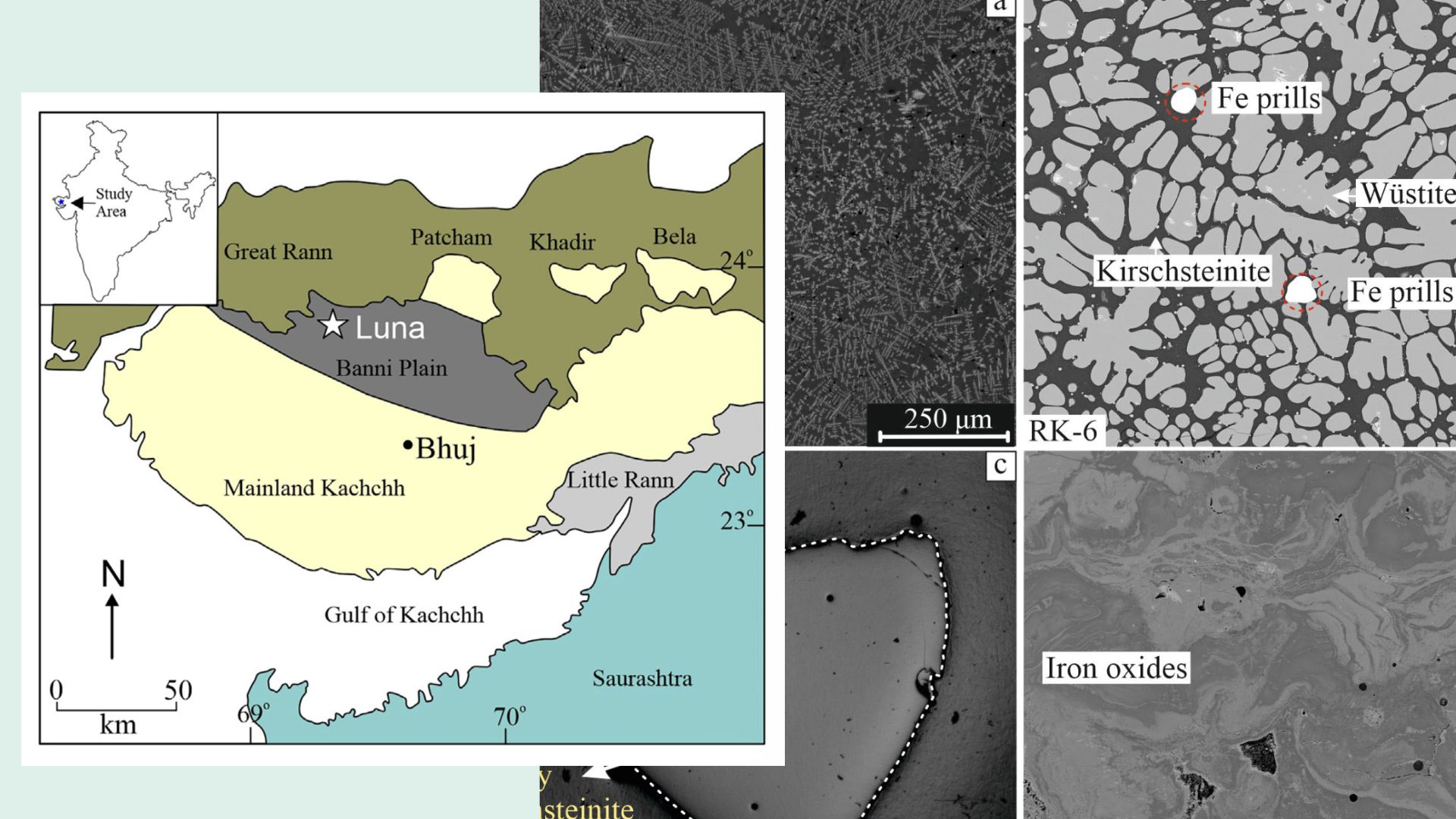
A massive 1.2-kilometre circular depression called the Luna Structure in the Banni Plains of Gujarat has long captivated geologists. Its crater-like shape and the presence of glassy, dark rocks scattered around its rim make it seem like an aftermath of a violent collision. Recent studies even suggested that a meteorite slammed into the Earth here around 4,000 years ago. However, a new investigation by a team of geoscientists from the Physical Research Laboratory, Ahmedabad, the Scripps Institution of Oceanography, USA, and Babasaheb Bhimrao Ambedkar University could overturn this theory. Their study suggests that these mysterious rocks were not forged in a cosmic collision but rather in the blazing-hot furnaces of a Bronze Age civilisation, the Harappans.
The researchers reached this conclusion after closely examining the rocks' atomic structure. When a meteorite crashes into Earth, it brings along a very specific chemical signature from space. Meteorites are often rich in a class of metals known as highly siderophile elements (HSEs), which are specific iron-loving metals that chemically bond easily with iron. HSEs include metals like iridium, osmium, and ruthenium, which are incredibly rare on Earth's surface but abundant in asteroids. Furthermore, iron from space almost always contains high amounts of nickel and cobalt.
The researchers gathered over 100 glassy rock fragments from the Luna Structure. They then analysed the rocks using X-ray fluorescence and mass spectrometers, which allow scientists to detect the exact elements and rare isotopes that make up the rocks. The chemical fingerprints they observed, however, did not point to space but to human activity on Earth. The team discovered that the rocks contained almost no iridium or osmium, matching the typical composition of Earth's crust rather than that of a space rock.
Even more telling was the iron trapped inside the samples. The iron was rather pure, lacking the nickel and cobalt signatures that define extraterrestrial metals. They also noted the total absence of shatter cones or planar deformation features, which are cracks in quartz crystals that form under the immense shockwave of a space impact.
The researchers propose that the glassy fragments could be slag, the rocky waste material left over after ancient humans melted down local ores to extract copper. They suggest that the intense heat of a human-made smelting furnace could have formed the high-temperature minerals similar to those produced by a meteorite impact. This led the team to conclude that the Luna Structure is not a meteorite impact crater, but rather an ancient industrial site belonging to the Bronze Age Harappan Civilisation.
This discovery could rewrite the history books for this region, overturning deeply held beliefs in both geology and archaeology. Geologists may have to rethink how the landscape of the Banni Plains actually formed, without a powerful collision from space. For archaeologists, the findings transform a presumed natural anomaly into a massive, ancient industrial zone. The study shows that the Harappan Civilisation had an even larger and more technologically advanced metalworking footprint than previously imagined. It suggests that over 4,000 years ago, these ancient engineers were capable of operating high-temperature smelting furnaces on an impressive scale right on the edge of the coastal mudflats. It provides a valuable new window into the remarkable technological capabilities of our Bronze Age ancestors, reminding us that some of Earth’s geological features come not from the stars but from human hands.