A new study using fruit flies led by scientists from the Indian Institute of Science Education and Research Thiruvananthapuram (IISER TVM) and Okayama University, Japan, has shed light on the signalling link between nutrient status and sleep.
The study was focused on a specific neuropeptide called CCHamide1 (CCHa1).
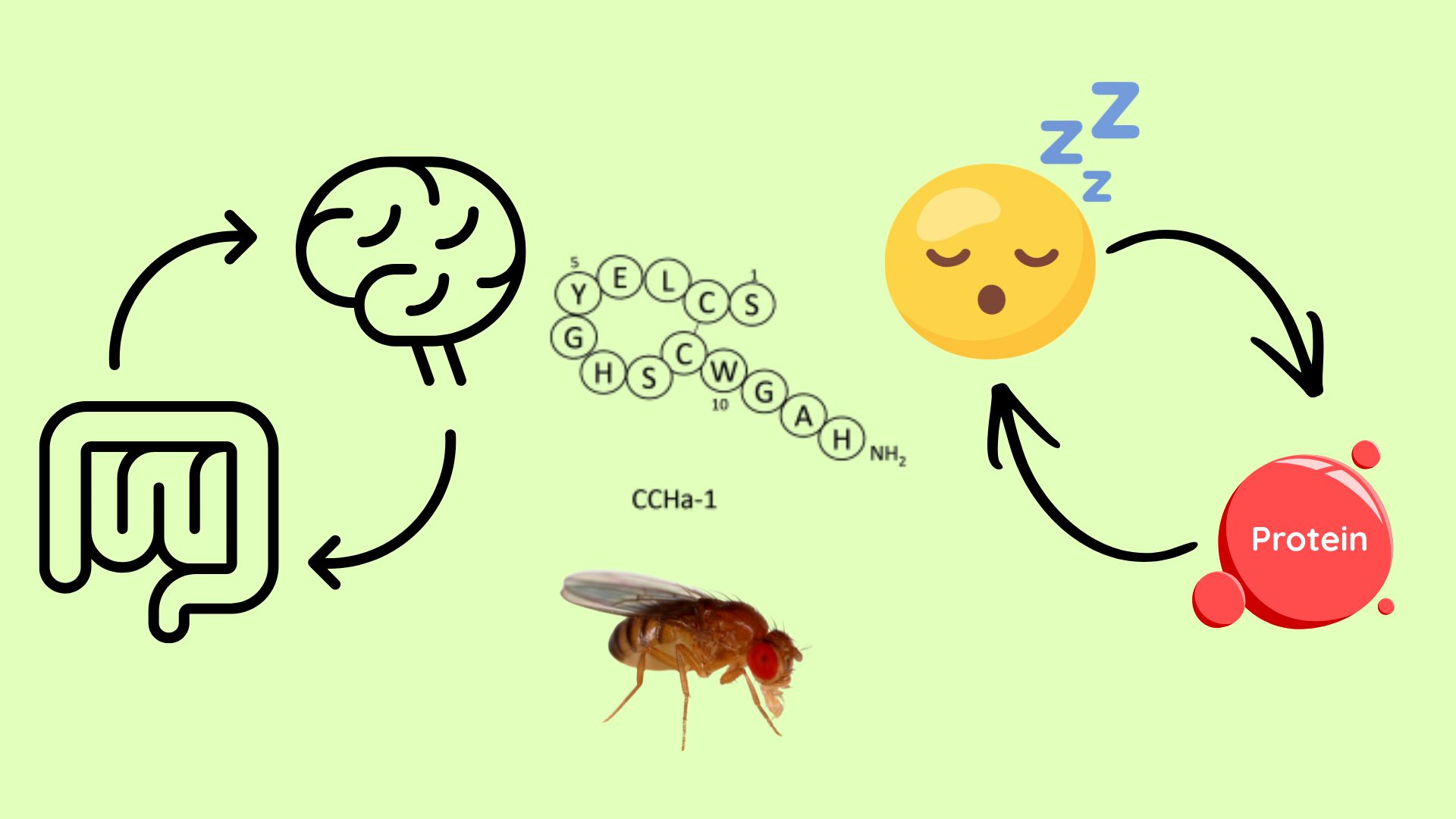
“CCHa1 is a neuropeptide, a small protein involved in regulating neuronal processes. It is expressed in the brain circadian clock neurons as well as in the gut of flies. Clock neurons house internal timekeeping mechanisms, and CCHa1, present in them, contributes to the maintenance of the circadian rhythm. Additionally, in the gut, CCHa1 functions as a sensor of the protein levels. Importantly, this nutrient information is communicated to the brain, linking metabolic state with neuronal circuits that regulate behaviour,” explains the corresponding author, Dr Nisha N Kannan, Associate Professor at IISER TVM.
By investigating this tiny molecule, researchers at IISER TVM were keen to understand the role of CCHa1 in nutrient status-mediated changes in sleep. Their study forms a foundation for understanding how food composition influences sleep quality and the underlying mediators of this effect.
“CCHamide1 is not a new discovery”, adds Dr Kannan, “but its role in the gut-brain axis is now being fully appreciated”.
The gut and the brain communicate in a bidirectional manner, usually referred to as the gut-brain axis. When an organism consumes food, the gut must accurately detect the nutrients entering the system and relay this information to the rest of the body. CCHa1 is known to specifically sense the protein levels in the gut. The researchers were interested in understanding the impact of CCHa1 on the gut-brain axis signalling and regulating sleep in response to protein availability. To address this, they used flies lacking the gene that encodes CCHa1, aka the ccha1 mutants.
“When we examined the sleep in the ccha1 mutants, it was observed that these flies have increased sleep fragmentation. They woke up more often and took shorter naps. Under a high-protein diet, ccha1 mutant flies showed pronounced sleep fragmentation, whereas on low-protein food, their sleep was consolidated as that of control flies. In mammals, protein in the food is associated with satiety and improved sleep when available ad libitum, although excessive food intake close to bedtime can cause sleep disruption. In Drosophila, however, increased protein levels are associated with increased sleep fragmentation, and ccha1 plays an important role in consolidating sleep under high-protein food by sensing the protein content and regulating the food intake. We further explored the gut-specific role of ccha1 in modulating the sleep quality” adds Swetha Gopalakrishnan, lead author of the study.
They found that manipulating CCHa1 levels in the gut influenced sleep fragmentation, leading to the conclusion that gut-specific CCHa1 protein sensing plays a key role in regulating how flies sleep. This study found that CCHa1 signalling is required to maintain stable sleep under a high-protein diet.
“The mutants overeat and also have high fat storage, which keeps them resistant to starvation; however, we believe this led to long-term metabolic stress and their bodies aged faster,” adds Gopalakrishnan.
Additionally, they observed that the ccha1 mutation had widespread effects on different fitness parameters.
“Another interesting observation that came from our study is that pre-adult development was delayed in these mutants, and they exhibited enhanced reproductive output with a significantly shorter lifespan. This study shows changes in an organism's ability to sense protein content in the food influence its behaviour, food intake, metabolism and overall fitness”, explains Dr Kannan.
Nutrient-dependent sleep regulation is conserved across species. This study from Dr Kannan’s lab, using fruit flies, integrates sleep regulation, metabolism, and lifespan outcomes resulting from the deletion of the small protein-sensing molecule CCHa1.
“Furthermore, previous studies on the gut-brain axis have shown that the gut-derived CCHa1 signalling to the brain dopaminergic neurons plays an important role in regulating sleep. However, none of the studies addressed whether CCHa1-dopaminergic neurons could also contribute to regulating metabolism. Although our results demonstrate that gut-specific CCHa1 signalling regulates sleep in a nutrient-dependent manner, we have yet to confirm whether the observed effects on sleep fragmentation and metabolism originate from the gut, the brain, or from gut-brain communication. The future research in the lab is focused on addressing some of these questions,” concludes Dr Kannan.