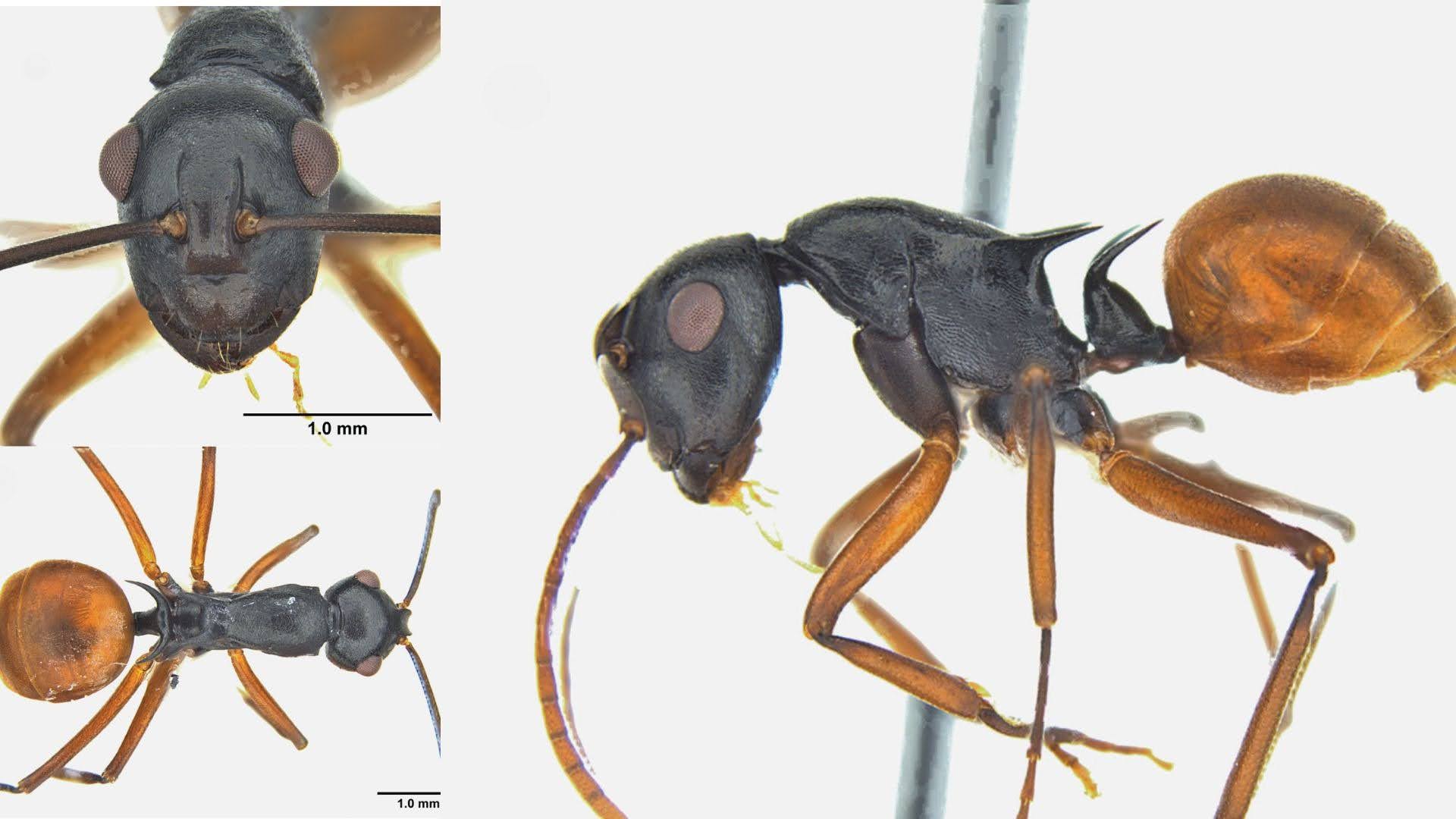
Researchers have discovered a new species of spiny ant with a bright yellowish-orange abdomen living in a forest fragment near the rapidly urbanising city of Guwahati in Assam. Uncovered during a recent field survey using simple pitfall traps, the newly named Polyrhachis garbhangaensis or Assamese Spiny Ant highlights the surprising biodiversity hidden within city borders. The discovery was made by researchers from the National Institute of Advanced Studies, Manipal Academy of Higher Education, St. Joseph‘s University, and Trans-Disciplinary University of Health Sciences and Technology.
While studying how urban development impacts local insect populations, the team set up traps along a 200-metre stretch near a stream in the Garbhanga Reserve Forest, leaving them out for 48 hours to see what crawled inside. They named the new insect in honour of this specific geographical home.
Belonging to a highly diverse global group of ants famous for their thorny bodies, this new species stands out dramatically from its closest Indian relatives. While similar spiny ants in the region are entirely black, the Assamese Spiny Ant sports a distinctive bright yellowish-orange back end. Furthermore, when scientists examined it under a microscope, they noticed its shiny head is uniquely textured with fine, minute grooves. It also features moderately long, thin, and gracefully curved spines on its midsection, which easily distinguishes it from its cousins that possess either extremely thick, straight, or excessively long spines.
Fascinatingly, the researchers also discovered a spider from the same location that has evolved to perfectly mimic the Assamese Spiny Ant’s appearance. In biology, this is a clever survival trick known as Batesian mimicry, where a harmless creature disguises itself as a tough, spiny, or unappetizing one to fool predators. This biological game of dress-up suggests that the newly discovered ant is likely a dominant force in its local ecosystem, shaping predator-prey dynamics.
Finding such unique life forms on the fringes of a major city reminds us of the importance of protecting fragmented urban forests, proving that these patches of green are vital sanctuaries for complex and undiscovered wildlife.