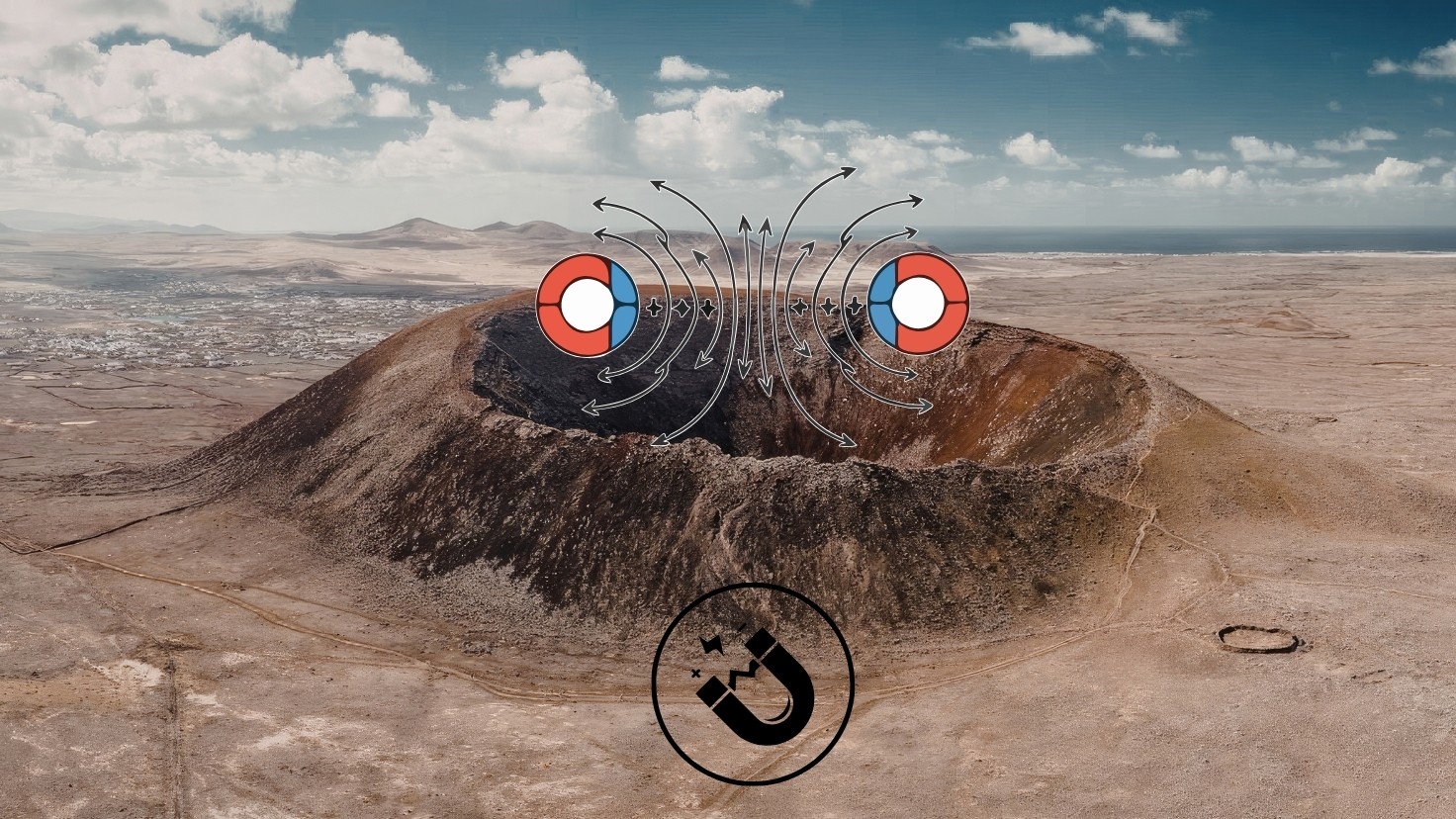
Scientists might have found an answer to a long-standing puzzle about why the rocks around massive meteorite craters often lose their magnetic properties. By examining the ancient Dhala impact structure in Madhya Pradesh, the team discovered that the sheer force of a meteorite's shockwave physically shatters the internal compasses of atoms that make the rocks, erasing their magnetic memories. The new study, conducted by researchers from the Indian Institute of Technology (IIT) Kanpur, Savitribai Phule Pune University and CSIR-National Geophysical Research Institute, could help explain mysterious magnetic dead zones around impact craters observed not only on Earth but also around colossal craters on Mars.
The researchers studied the 2.5-billion-year-old Dhala crater, collecting samples of three distinct rock types: untouched impact rocks, violently shattered rocks called monomict breccia, and rocks that completely melted during the cosmic strike. Back in the laboratory, they subjected these cylindrical rock samples to microscopic scrutiny, heating cycles, and magnetic testing.
They found that the untouched rocks held a strong, stable magnetic record carried by a mineral called titanomagnetite. The atoms within the mineral act as billions of microscopic compass needles that freeze in place, recording the direction of the Earth's magnetic field at the time the rock formed. The melted rocks also showed strong magnetism because they cooled from a liquid state and essentially retained the current magnetic field, like a freshly formatted hard drive. However, the shattered breccia rocks exhibited extremely weak and erratic magnetic signals.
The study shows that when the meteorite slammed into the Earth, the resulting shock wave was so intense that it caused microscopic fractures and drastically reduced the grain sizes of the magnetic minerals inside the rocks. In normal rocks, these magnetic areas act as stable magnetisation states, known as multi-domain states. The immense pressure during impact crushed these domains into much smaller, highly unstable sizes, while also physically rotating the microscopic grains into random orientations. This intense physical scarring scrambled the tiny internal regions that act like microscopic bar magnets, making it impossible for the shattered rock to maintain a steady magnetic direction.
Scientists largely believed that rocks lost their magnetism during high-energy events, mainly because they were heated past a specific temperature limit by the impact. It was also assumed that shock demagnetisation mattered only on planets like Mars after their global magnetic fields had already died out. This new study provides evidence that shockwaves alone can substantially erase a rock's magnetic signature even in the active presence of a strong, ambient magnetic field like Earth's.
The understanding of how violent impacts erase magnetic memories benefits society today by sharpening the sophisticated tools we use to explore both our own planet and the frontiers of space. These ancient impact sites often trap valuable groundwater or host massive deposits of rare mineral resources essential for modern technology. Furthermore, it gives us a much clearer lens through which to view the history of our entire solar system, allowing us to accurately read the magnetic diaries of other planets and better understand the catastrophic cosmic events that shaped the rocky worlds around us.