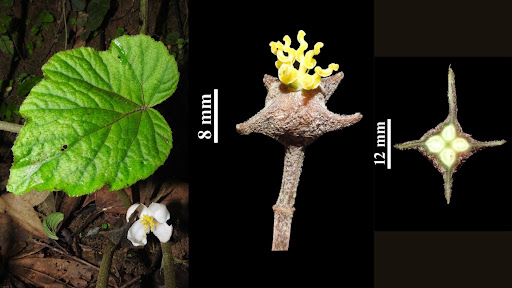
Researchers from the Indian Institutes of Science Education and Research (IISER) Pune and Savanna Science Foundation have discovered a new plant species, named Canscora agni, in the fire-prone savannas of western India. Found recently on Sus Hill in Maharashtra's Pune district during routine vegetation surveys, this tiny plant highlights the often-misunderstood role that natural fires play in keeping ecosystems healthy. Researchers Ashish N. Nerlekar and Sharad Suresh Kambale initially stumbled upon the plant while documenting old-growth savannas, spotting a small herb with white petals and uniquely winged stems.
At first glance, the specimens seemed to match the description of a known plant called Canscora alata. However, after a decade of field observations and careful analysis, which involved comparing their collected specimens with historical plant records, global catalogues, and the original physical examples of C. alata, the researchers realised they had found a new species.
Canscora agni has several unique characteristics that easily differentiate it from its closest relative. While C. alata can grow into a tall herb up to 60 centimetres, the newly discovered C. agni is a dwarf herb reaching a maximum of only 10 centimetres. It also features fewer and shorter leaves, measuring up to 11 millimetres long. Closer examination of its stems reveals that the wing-like structures are uneven, being wider below the flowers and narrower towards the stem. Additionally, it has special minute glandular hairs on its leaves, a shorter ovary, and distinct web-like (reticulate) veins on the wide wings of its flower base (the calyx), all traits that are completely absent in its taller cousin.
The name of the new species acknowledges one of the most powerful yet misunderstood forces of nature and its role in conservation. The specific name 'agni' means 'fire' in several Indian languages, including Marathi, which is the most widely spoken language in the area where the plant was discovered. The researchers deliberately chose this name to challenge the popular belief among the public and some scientists that all fires are destructive.
In the ancient Indian savannas, frequent natural fires are a vital force of nature that clear away overgrown woody vegetation, allowing native grasses and unique dwarf plants like C. agni to thrive. By naming the plant after fire, the scientists hope to spark a better appreciation for the natural role of wildfires in maintaining savanna biodiversity.
Sadly, because the plant relies on these open, grassy habitats, it is already facing severe threats. The researchers suggest classifying Canscora agni as 'Critically Endangered' because it has been found in only one tiny location, and modern land management policies that suppress fires and promote large-scale tree planting are actively destroying the very environment this rare botanical treasure needs to survive.