As India celebrates National Technology Day to commemorate the 1998 Pokhran nuclear tests (Operation Shakti) and honour achievements in science and engineering, the spotlight is increasingly shifting toward the frontiers of tomorrow. Chief among these is quantum technology, which harnesses the bizarre principles of quantum mechanics, such as superposition and entanglement. By leveraging these phenomena, scientists are creating entirely new functionalities in devices and systems, promising transformative impacts across everything from faster computation and ultra-precise sensing to a fundamentally redefined understanding of the building blocks of the universe.
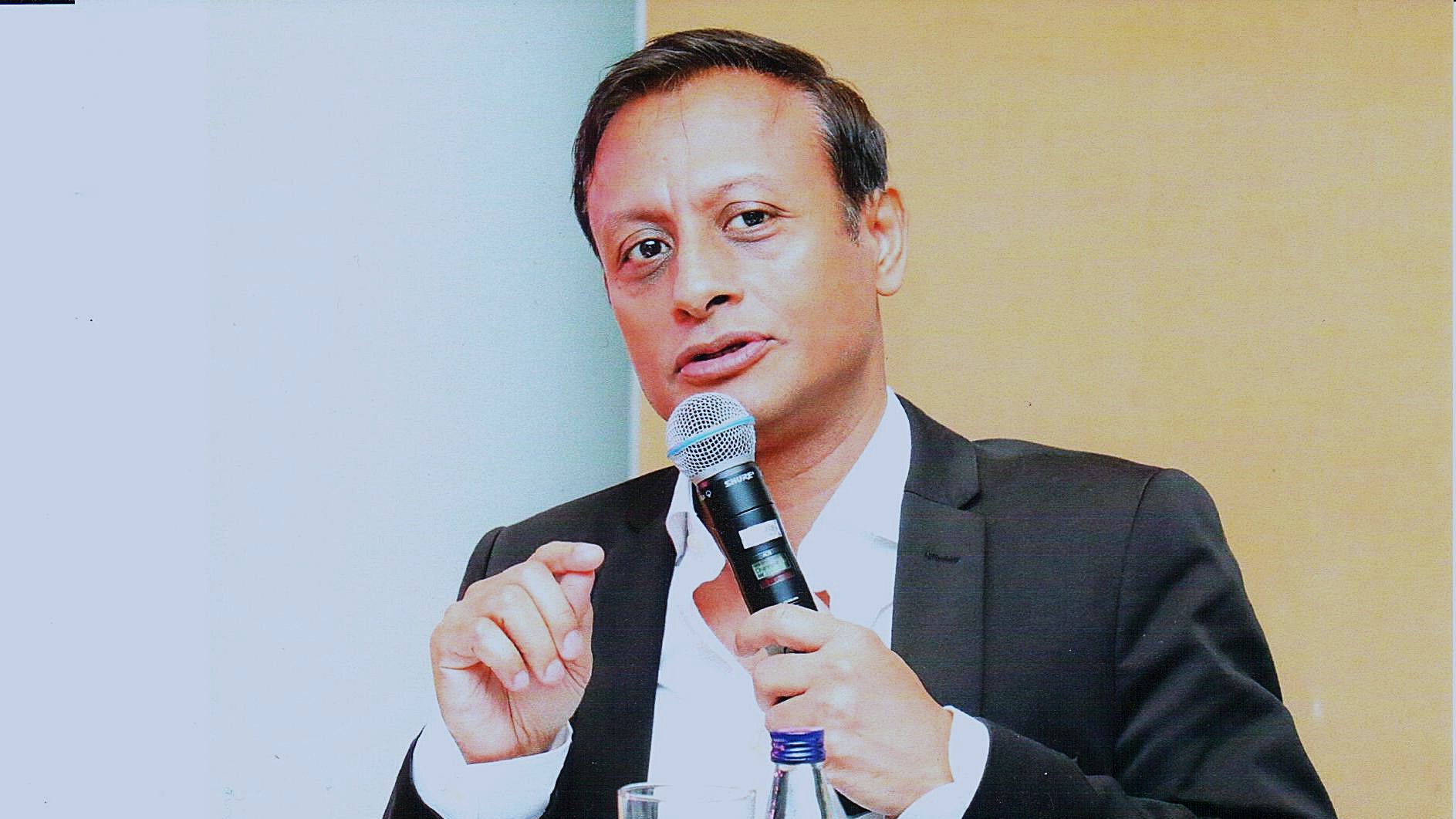
To understand India’s role in this frontier technology, Research Matters caught up with Arindam Ghosh, a professor at the Indian Institute of Science (IISc) and a central figure in India's quantum landscape.
“Quantum technologies are a very broad term. It includes fields, like quantum computation and communication, quantum metrology and sensing and quantum materials. My team is working on materials that can have an impact across all these fields,” remarks Prof Ghosh.
Prof. Ghosh’s work is at the cutting edge of quantum materials research, focusing primarily on two-dimensional materials. He is pioneering the development of atomically thin semiconductors, laying the groundwork for a new generation of electronic and optoelectronic devices. His group has developed ultra-sensitive technology capable of detecting electromechanical responses from freezing millikelvin temperatures to room temperatures. This breakthrough enabled the world’s first direct detection of single photons using graphene and 2D materials, pushing the boundaries of single-photon detection and quantum device research.
Quantum Materials and the Manufacturing Challenge
Quantum materials research forms a critical pillar of this new technology era. Realising the potential of quantum technology requires moving away from growth and manufacturing strategies of conventional applications and venturing into the design and synthesis of novel materials. This includes superconductors, topological materials, and novel semiconductor structures engineered at the atomic level.
“There are three main aspects of quantum materials research. One: exploring the physical properties of quantum particles, like their topology or spin, for new applications. Two, exploring a whole new class of materials utilising quantum mechanical principles, like new superconductors. And finally, to improve the existing materials and systems by adopting improved instrumentation and growth protocols,” explains Prof Ghosh.
Manufacturing the materials required in the quantum age is an exercise in extreme precision. These materials are essential for fabricating the components required for quantum devices, such as single-photon detectors and entangled photon sources.
“Quantum materials manufacturing is a very precise process. It involves creating some of the purest materials in the form of single crystals and working at ultra-low temperatures, since that’s when quantum properties become detectable,” says Prof Ghosh.
While India is making significant strides in establishing new quantum device manufacturing hubs, it is still largely dependent on imports for materials and devices required for quantum materials research.
“India has very good material research and engineering labs. It has a long history of materials research, including here at IISc. But the kind of precision engineering needed to make quantum technologies work, we still can’t do that at scale. We are beginning to see this changing with new startups being established,” remarks Prof Ghosh.
Quantum Computation: Powering AI and Frontier Tech
Once these advanced materials are manufactured, they become the building blocks for various quantum technologies, including quantum computing. While classical computers process information in binary bits (0s and 1s), quantum computers use qubits, which can exist in multiple states simultaneously, significantly reducing computing time for certain algorithms. In the realm of AI, quantum algorithms can exponentially accelerate machine learning training, optimise complex logistical problems, and simulate molecular structures for rapid drug discovery.
“There is no doubt that quantum computing is going to have a huge impact on the future of computing and AI. A lot of the transformer architecture that AI depends on can be implemented much more effectively and efficiently on a quantum computer, which means lower energy consumption and faster computation. This can maybe happen in the next 5-10 years. However, currently we are just at the beginning. We are seeing breakthroughs, including from big tech companies like Google’s claim of quantum supremacy in 2019, but they are limited to specific niche cases,” explains Prof Ghosh.
India is aggressively pursuing this frontier, with a strategic goal of developing intermediate-scale quantum computers ranging from 50 to 1000 physical qubits before 2031, utilising both superconducting and photonic platforms.
“India has a few quantum computers, including one here at IISc. Some states are also buying quantum computers from companies like IBM. These are early-stage quantum computers with 50 to 100 qubits or so. It’s not very helpful for actual computational work, but can be used as a teaching tool or to test simple new algorithms. We should now be focusing on expanding our capabilities in this area,” states Prof Gosh.
The National Quantum Mission: Shaping India's Future
To ensure India does not miss out on this revolution, the government formally launched the National Quantum Mission (NQM) in April 2023. Backed by a budget of Rs. 6003.65 crore spanning until 2031, the NQM is designed to seed, nurture, and scale up scientific and industrial research and development in quantum technologies. The NQM has rapidly built an ecosystem encompassing 152 researchers across 43 institutions in 17 states. Recognising that commercialisation is key, the mission is already actively supporting eight promising quantum startups. Furthermore, in collaboration with AICTE, India is future-proofing its workforce by introducing specialised B.Tech and M.Tech curricula in Quantum Technology.
“I was part of the discussion when the NQM was being conceived. It was created to give an impetus to the quantum ecosystem. The mission will support the creation of startups and the commercialisation of the products, so that, instead of just doing research, we also generate value for the country. The goal is to set up the entire ecosystem, from the manufacturing of even the tiniest components, to training the required skill force to operate the quantum technologies, so that it can then economically help the country. It’s not an academically oriented but a market-oriented mission,” says Prof Ghosh.
As we reflect on National Technology Day, it is clear that India’s technological narrative is evolving. Through a comprehensive approach, India is positioning itself to become a global player in quantum technologies and applications, driving economic and scientific growth over the coming decade. And for anyone too intimidated or confused by quantum physics, Prof Ghosh has a suggestion:
“Don’t be afraid of the word quantum. The technological part is pretty algorithmic; you just have to follow simple rules and formulas. So, even if you don’t understand or like quantum physics, that shouldn’t stop you from participating in the larger quantum technological ecosystem,” he concludes.