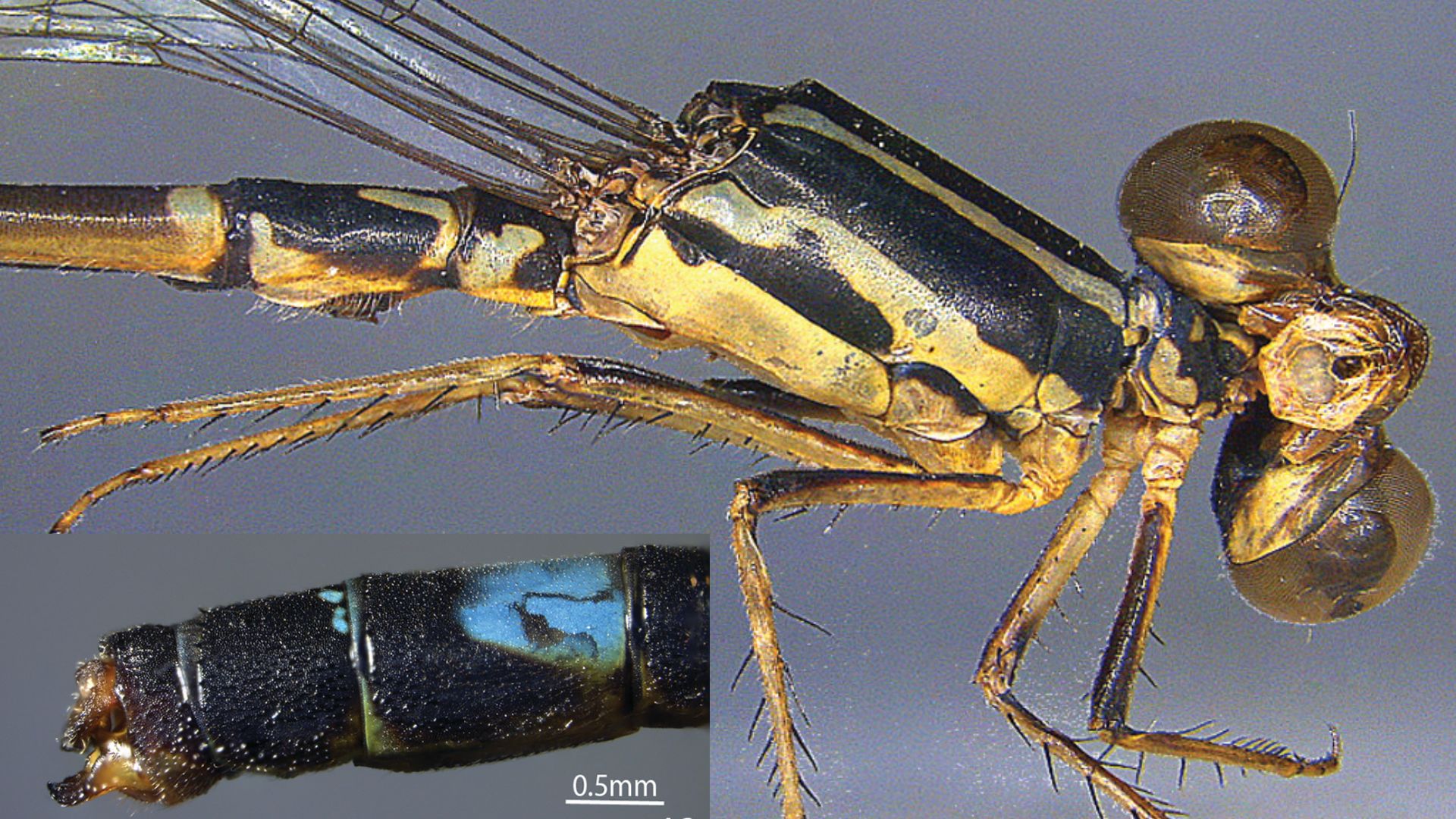
Scientists from the Zoological Survey of India and the University of Madras have discovered a new species of damselfly, named Mortonagrion santha, among the tropical vegetation of the Andaman and Nicobar Islands. Researchers John I. Christopher, Rajappa Babu, and Kumarapuram A. Subramanian made the find by sweeping an aerial insect net around a small farm pond surrounded by a coconut plantation in Dasarathpur, Rangat tehsil in the Andaman and Nicobar Islands. First spotted in 2017 and confirmed through additional collections in 2019, the newly named insect highlights the incredibly rich yet still underexplored wildlife of the Indo-Burma biodiversity hotspot.
The new damselfly belongs to a genus of insects known for their incredible secrecy, often blending perfectly into the shaded coastal vegetation. The Mortonagrion santha’s physical distinct features separate it from its closest known relative, Mortonagrion arthuri, a species found further east in Southeast Asia. The new damselfly has unique pale-blue, crescent-shaped postocular spots located just behind its eyes, as well as a distinctive bright-blue splash of colour on its ninth abdominal segment. Under a microscope, M. santha also shows a uniquely shaped, three-lobed collar area (the prothorax) and different proportions in its tail-like mating appendages, where the upper parts are only about half the length of the lower parts.
The researchers officially chose the name M.santha to honour their colleague, P Santhakumar. Recognised as an excellent field entomologist, it was Santhakumar who actually waded into the field and carefully netted the specimens that made this research possible. The discovery of this tiny winged predator is a thrilling addition to the natural heritage of the Andaman Islands. Because damselflies play a crucial role in local ecosystems, acting as both predators of smaller insects and as food for larger animals, finding a new species right next to a rural farm shows that even human-altered landscapes can harbour undiscovered wildlife. The researchers hope this exciting find will inspire more systematic wildlife surveys across these remote, ecologically vital islands.