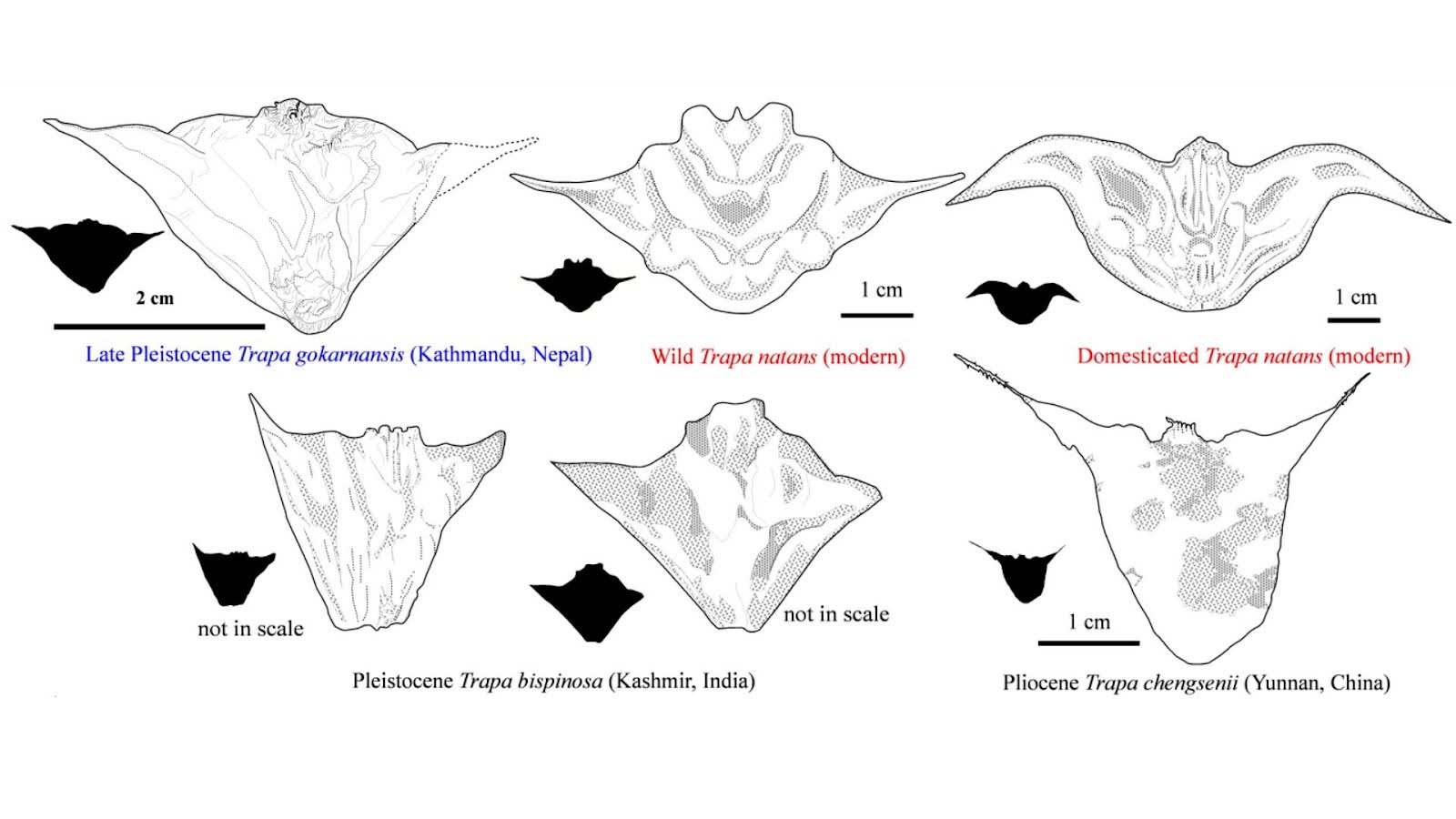
Scientists have discovered the fossilised remains of a previously unknown species of ancient water chestnut buried deep within the Kathmandu Basin in Nepal, providing a rare glimpse into the Himalayan environment from tens of thousands of years ago. The discovery of the fossilised fruit, named Trapa gokarnansis, suggests that this region of the Himalayas was once significantly cooler and wetter than it is today, serving as a vital refuge for plants during a period of dramatic climate change.
The find was made by an international team of researchers from the Chinese Academy of Sciences, China, Tribhuvan University, Nepal, and the Birbal Sahni Institute of Palaeosciences, India. The team recovered the well-preserved fossil fruit from the Gokarna Formation in the northeastern part of the Kathmandu Basin. It was found at a depth of 6 metres within layers of ancient clay and silt, dating to the Late Pleistocene, roughly 39,000 to 53,000 years ago.
While modern water chestnuts are common across Asia, this ancient relative is unique. By comparing the specimen with existing species, researchers identified several unique features that distinguish it. The fruit has a distinct egg-shaped (obovate) body with two wide horns at the top, a conspicuously swollen neck, and a triangular base. Unlike the common modern water chestnut (Trapa natans), this new species lacks a corona, a crown-like ring at the top, and is missing the lower horns and the stalk usually found at the bottom.
The plant's name, Trapa gokarnansis, follows scientific convention by honouring the location where it was found. The term derives from the Gokarna area and the Gokarna Formation of the Kathmandu Basin.
Beyond just identifying a new species, the discovery acts as a biological thermometer for the ancient Himalayas. The researchers determined that Trapa gokarnansis thrived in shallow freshwater lakes during periods when the Indian summer monsoon was much stronger, thereby expanding the lakes. However, the presence of this plant indicates that the average temperature at the time was approximately 6-7°C cooler than in modern-day Nepal. As the mountains rose and the climate shifted, these lake basins became refugia, safe zones where unique species could survive as the surrounding environment changed.