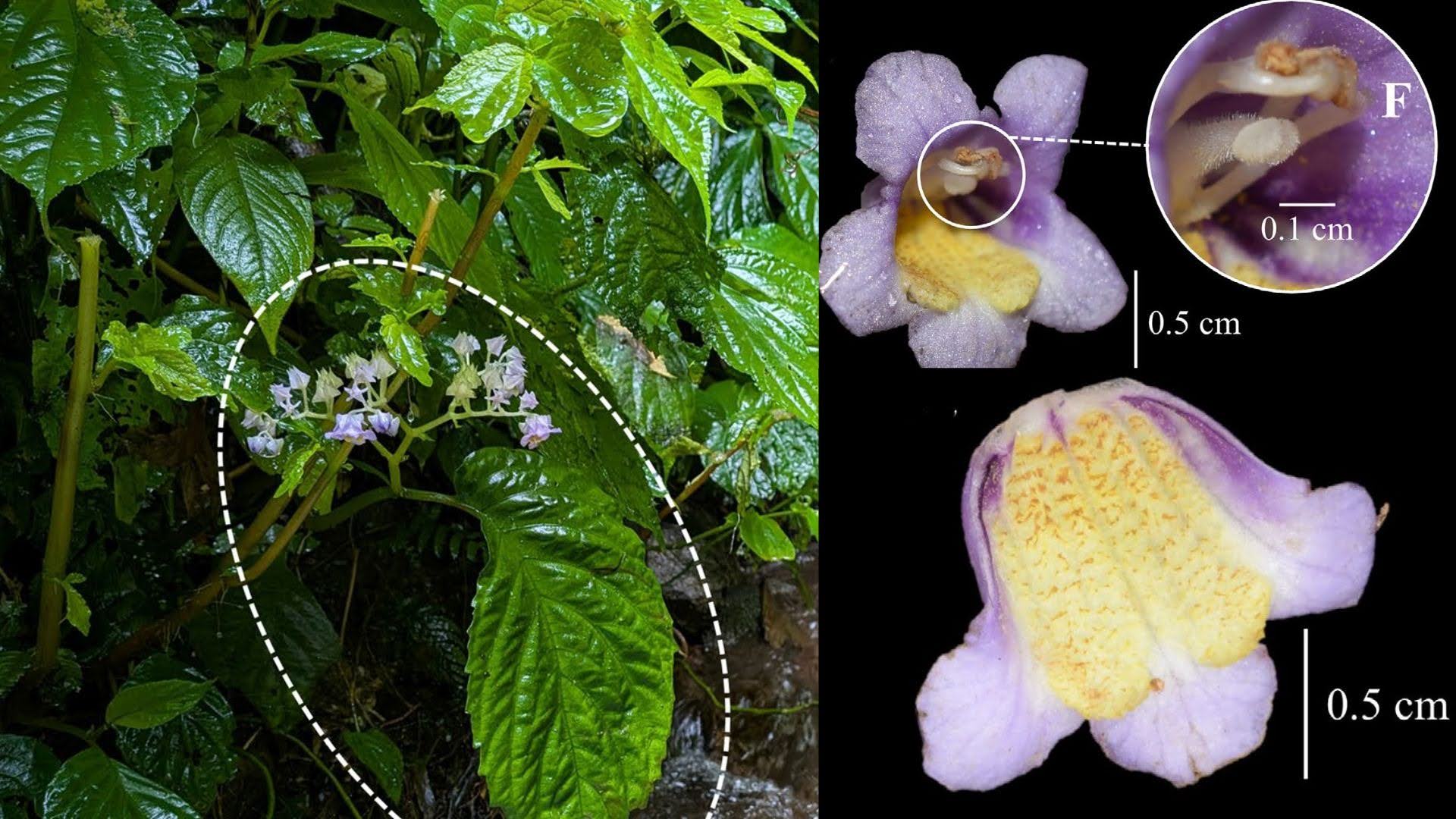
During a jungle expedition in August 2025, a team of botanists discovered a new plant species with a unique ‘golden tongue’ in the shaded streams of the Himalayas. Found in the northeastern state of Arunachal Pradesh, the new plant, named Stauranthera aureoglossa, was identified by researchers from Thackeray Wildlife Foundation and University of Trans-Disciplinary Health Sciences and Technology.
The discovery occurred while the scientists were conducting a routine plant-finding task, known as a floristic exploration, through the dense, mid-elevation evergreen forests of the Kamle and Upper Subansiri districts. There, the team spotted the unusual perennial herb clinging to damp rocks and soil right beside flowing streams and rivulets. When they examined the plant closely, the researchers realised it did not match anything previously recorded.
The plant stands out from its closest relatives with a distinct, bell-shaped, bluish-purple flower. Unlike similar species, its flower lacks a tubular projection called a spur at its base. Instead, it features a raised, bumpy, yellow patch inside the lower lip of its petals. This striking feature inspired its new scientific name, with “aureoglossa” translating to the golden-yellow, tongue-like appendage seen on the flower. Furthermore, while related plants have ear-shaped, smaller leaves, this new species sports diamond- or spear-shaped leaves.
Unfortunately, this newly discovered species is already facing threats to its survival in the wild. The researchers found only two small populations, roughly 20 kilometres apart, totalling fewer than 110 individual plants. Because their fragile streamside habitats are being actively damaged by logging, landslides, and road-widening projects, the scientists have provisionally classified this rare, golden-tongued herb as an endangered species.