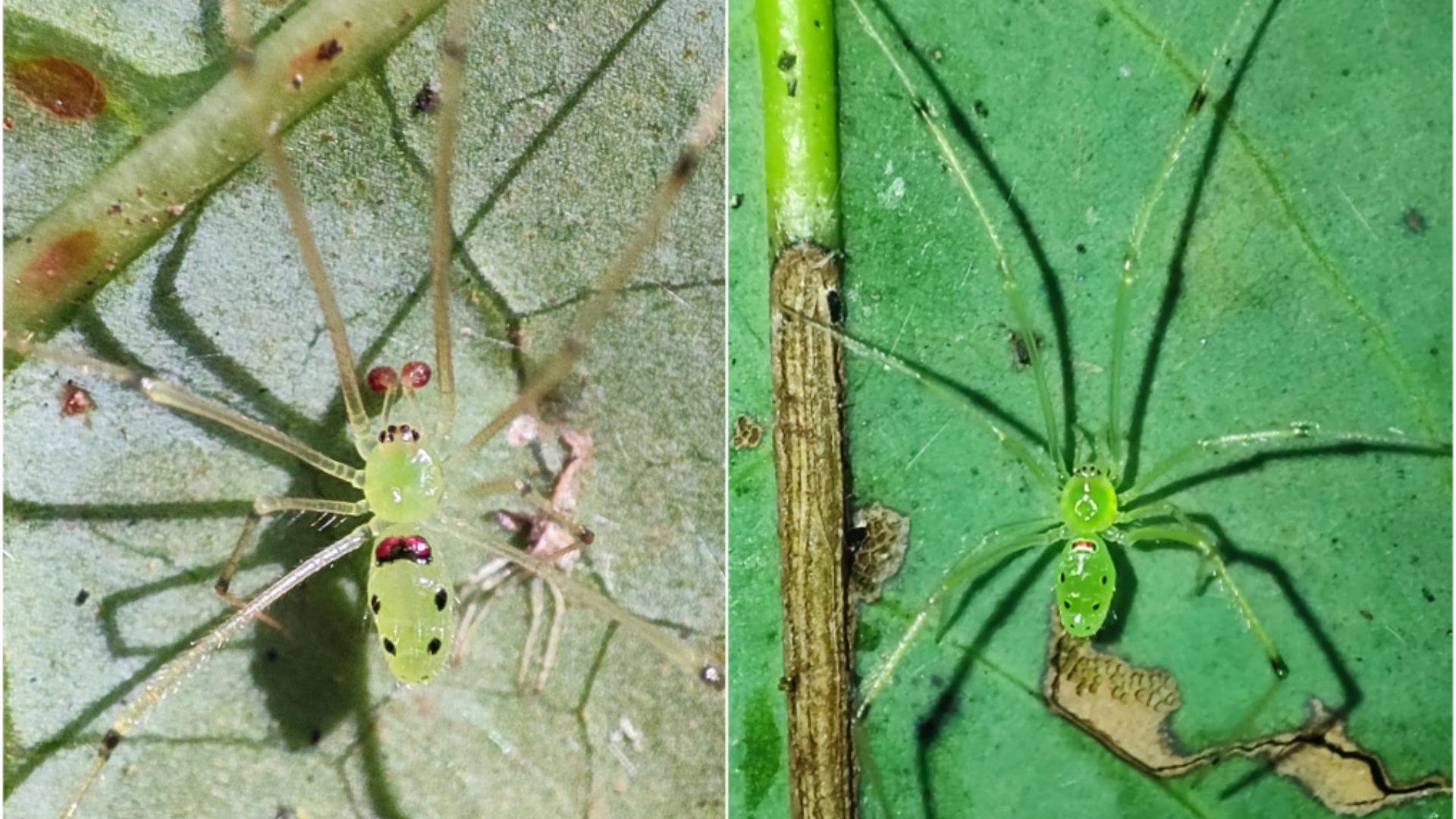
Researchers have discovered a new species of "happy-face" spider high in the Western Himalayas of India. Found hiding on the undersides of leaves in the mountainous forests of Uttarakhand, the tiny, brightly coloured spider, named Theridion himalayana, was uncovered by researchers Ashirwad Tripathy from Forest Research Institute, Dehradun and Devi Priyadarshini from the Regional Museum of Natural History during recent ecological field surveys. The remarkable arachnid frequently sports patterns resembling a smiling face on its abdomen, a bizarre evolutionary trait that has long fascinated biologists.
The research duo made their discovery while exploring the moist, temperate deciduous forests of the Chamoli and Rudraprayag districts. By capturing the spiders via bush beating, sweeping nets, and direct capture from the leaves of native plants, they collected over 60 specimens. They observed that these tiny spiders lead a quiet, highly specialised life, hanging upside down from thin strands of silk spun out of sight on the bottom of broad green leaves. As an ode to the extraordinarily biodiverse mountain range that the spider calls home, the scientists officially named the new species Theridion himalayana.
At first glance, this new Himalayan spider looks almost identical to the famous Hawaiian happy-face spider (Theridion grallator). However, closer laboratory inspection and DNA testing revealed crucial differences that prove it is an entirely separate species. Genetically, the Himalayan spider differs from its Hawaiian lookalike by about 8.5% to 12%. Physically, Theridion himalayana is uniquely set apart from all its closest relatives by its reproductive anatomy; the females possess distinct "sew-hook" shaped copulatory ducts and short, V-shaped fertilisation ducts. These internal structures are completely different from those of the Hawaiian species, proving that the two spiders evolved independently on opposite sides of the globe.
The Theridion himalayana was also found to show extreme polymorphism, a biological term meaning the species exists in many naturally occurring, wildly different colour patterns. The researchers identified an astonishing 32 distinct visual variations, or morphs, featuring different arrangements of red, black, and white dots. Interestingly, the spider's wardrobe seems strictly tied to its sex. The vast majority of females sport the vibrant red blob and white ring that creates the famous smiling face, a disguise that may help confuse predators while the mothers sit still to guard their egg sacs. Meanwhile, nearly 90% of the males lack the happy face entirely, possessing a plain, unpatterned yellow or cream body. This simple colouring likely serves as camouflage, helping the males blend into the leaves as they wander the dangerous forest canopy in search of a mate.
The discovery highlights the incredible, yet undiscovered, biodiversity of India's mountain forests. Studying this species offers crucial insights into parallel evolution and genetic camouflage. However, growing human interference and habitat degradation threaten their survival, making urgent conservation of these fragile Himalayan microhabitats an absolute ecological necessity.