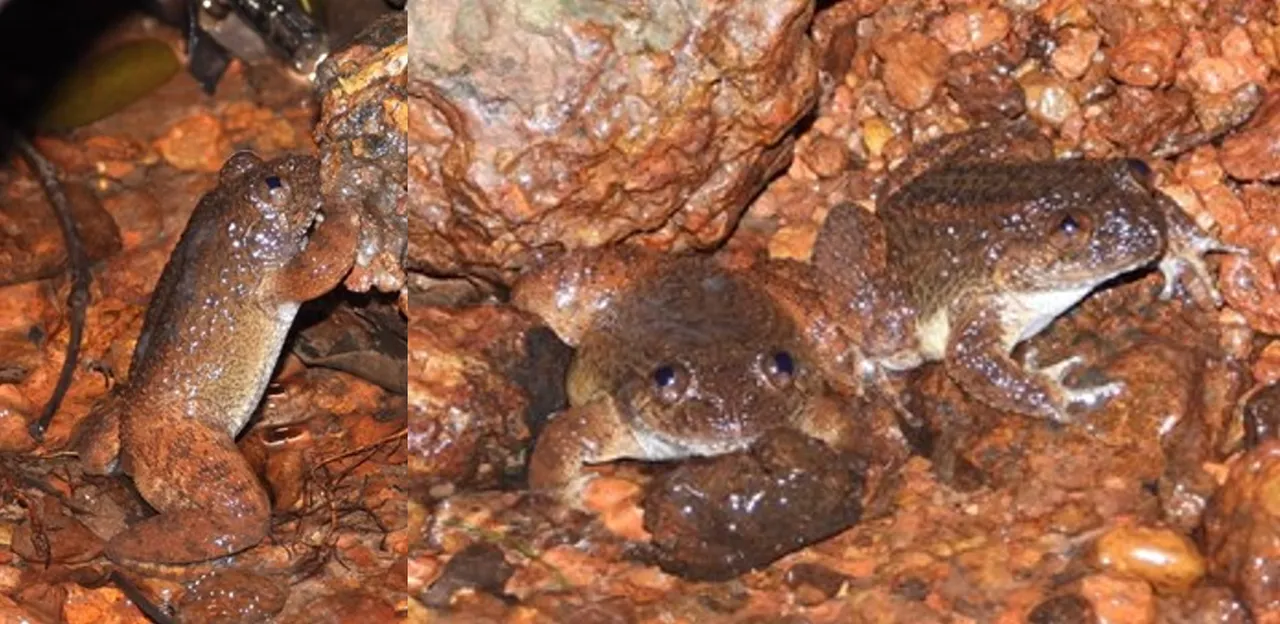
Nyctibatrachus kali (Kali Night Frog), a new cryptic frog species from Kali Tiger Reserve. Photo by Ramesh Badiger
In the humid, rain-drenched corridors of the Kali Tiger Reserve in Karnataka, a familiar “tock” sound led to an extraordinary scientific discovery. A collaborative team of researchers and frontline forest personnel has identified a new species of frog, Nyctibatrachus kali, commonly known as the Kali Night Frog. The discovery, published in the international journal PeerJ, marks a significant addition to India’s biodiversity, which currently hosts 474 amphibian species, which is approximately 5.3% of the global total.
A Tale of Two Frogs: The Mystery of Cryptic Species
The Kali Night Frog is what scientists call a cryptic species. While it appears almost identical to the previously known Nyctibatrachus kumbara (Kumbara Night Frog), it represents a distinct evolutionary lineage that has remained hidden from science until now.
"The discovery of the new species of frog, Nyctibatrachus kali, adds to the continued discoveries of frogs from the Western Ghats... It also highlights that there could be more cryptic species," explains Dr Preeti Hebbar, Assistant Professor at MIT Bengaluru and lead author of the study.
The researchers were motivated to investigate further when they encountered these frogs in the Castlerock region, over 100 kilometres away from the known distribution range of the Kumbara frog.
To confirm the new species, the team employed a rigorous combination of morphological, acoustic, and phylogenetic analyses. Molecular phylogeny based on mitochondrial genes revealed a genetic divergence of over 5% in the 16S rRNA gene and more than 10% in the ND1 gene compared to its closest relatives.
"The new species Nyctibatrachus kali is morphologically cryptic but differs in advertisement calls and genetics from all current 34 species," explains Aravind CK, a PhD Scholar from MIT Bengaluru and co-author of the study.
"The call resembles the sound of wood chopping, and by hearing it is similar to the calls of other species in the N. sanctipalustris group. Similar to other species in the group, N. kali also has two distinct advertisement calls, where one is a low-frequency call, and the other is a high-frequency call".
Science from the Frontlines
A unique hallmark of this study is the active involvement of frontline forest staff. CR Naik, a Deputy Range Forest Officer, first recorded the frog's unique sound on his mobile phone during a bike ride in heavy rain, while Ramesh Badiger, a Beat Forester, assisted in locating the frogs and documenting their reproductive behaviour.
“It is our hope that we all have the interest and tendency to listen to the forest as well as see it,” said Naik.
This collaboration highlights a growing "scientific temperament" within the forest department, moving beyond traditional protection duties to active research participation. Kumar Pushkar, IFS, Principal Chief Conservator of Forests (Wildlife), Karnataka Forest Department, expressed his commendation for this partnership:
"I am extremely happy to note that our Forest department frontline staff... have played a very important role in the identification of this new species. This speaks of the scientific temperament and the zeal present in our Frontline staff, who, besides the protection and development works, are contributing to scientific research".
The Urgent Need for Conservation
The discovery of the 35th species of Night Frog comes at a critical time for global amphibian populations. Nearly two out of every five species currently face the threat of extinction due to habitat loss, climate change, and emerging diseases. Because N. kali is a stream-dwelling species with a likely restricted range, its survival is inextricably linked to the health of the Western Ghats' delicate water networks.
As Aravind CK notes, the significance of this find extends beyond a single name on a list: "Conserving N. kali and its habitat have a significance for the conservation of the stream networks and the other species that are associated with the stream".
This discovery serves as a reminder that even in well-studied hotspots, the forest still holds secrets that can only be uncovered when field experience meets scientific curiosity.
The identification of N. kali is crucial for conservation planning, as cryptic species often have restricted ranges that are easily overlooked. As a stream-dwelling species, the health of N. kali populations is directly linked to the conservation of the forest's stream networks.
Prof. Gururaja KV of the Srishti Manipal Institute emphasised that "conservation needs collaboration with people, practice and policy".
This discovery serves as a testament to what can be achieved when field experience meets scientific curiosity.