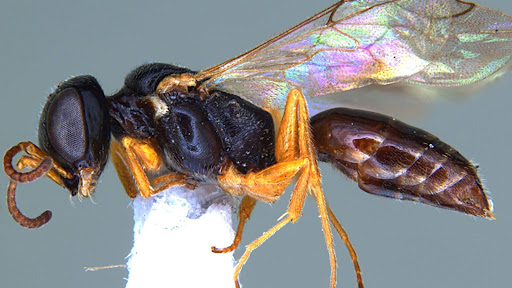
Scientists in India have discovered a new species of wasp that hunts plant pests. The newly named Spilomena malabarica, a type of aphid wasp, was identified by researchers S. Amal and P. Girish Kumar from the Zoological Survey of India. The discovery was made in the Kozhikode district of Kerala after a specimen was caught using a yellow pan trap. This find marks the 11th species of this specific wasp genus found in India and the 98th discovered worldwide.
Measuring just over 3.5 millimetres long, this tiny black-and-brown insect shows highly distinctive features under a microscope. The wasp stands out from its closest relatives due to a specific wing pattern. It possesses only a single submarginal cell, a distinct enclosed area formed by veins on its front wing. While it shares this rare wing trait with its closest known cousin, Spilomena unus, the newly discovered species is easily distinguished by its head shape. Its head is not unusually elongated; the distance between its eyes and the top of its head is well proportioned; and it features a flatter face, known scientifically as a less convex clypeus, setting it apart from other wasps in its family.
The new insect's name is a direct nod to its geographical roots. The scientists chose the specific name malabarica in honour of the historic Malabar region of Kerala, where the type specimen was collected. The wasp was actually collected by another researcher, K. Ayana Sudheer, who placed yellow pan traps in the area. These traps attract insects with their bright colour, then safely capture them in a shallow liquid, allowing the scientific team to secure the intact specimen for detailed study with high-powered stereomicroscopes and modern 3D imaging software.
Beyond just adding another insect to the record books, this tiny wasp is stirring up an interesting debate among scientists. The discovery of Spilomena malabarica, along with its unique wing structure and distinctive head features, blurs the established physical boundaries between the wasp groups Spilomena and Arpactophilus. The researchers suggest that in the future, comprehensive DNA studies and an observation of their life cycles might be needed to completely reorganise how these fascinating, aphid-hunting insects are classified on the evolutionary tree of life.