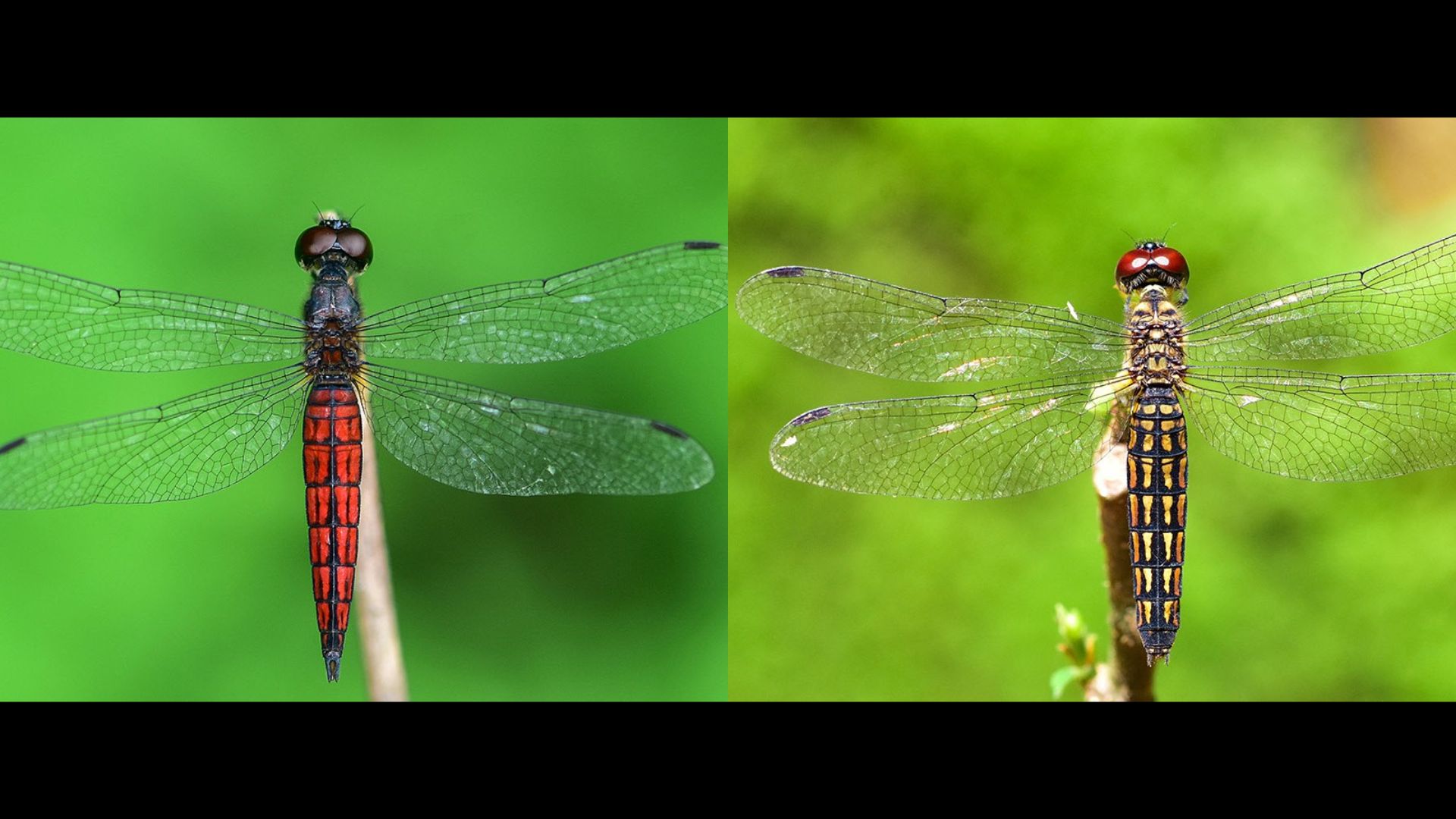
A team of Indian researchers has officially identified a new species of dragonfly living in the coastal plains of Kerala, southern India. The discovery introduces Lyriothemis keralensis, commonly known as the Slender Bombardier. Despite living in areas frequently visited by people, the insect had been overlooked for years because it was mistaken for a common, look-alike relative.
The discovery was led by researchers from the Indian Foundation for Butterflies, Kerala Agricultural University, the National Centre for Biological Sciences and others. The breakthrough occurred after Renjith Jacob Mathews spent five years monitoring the dragonfly population in the village of Varapetty. He observed the insects living in the shade of home gardens and rubber plantations near small irrigation canals. Although they were initially thought to be the known species L. acigastra, a closer look revealed that they were a distinct, previously undescribed species.
To confirm the find, the team compared the new specimens with historical records and museum samples from as far away as London and Brussels. The Slender Bombardier is distinguished by its namesake trait: a notably thin abdomen. While its closest relatives have thicker, bulged bodies, L. keralensis is much more streamlined. Under a microscope, scientists also found that the male's mating organs (secondary genitalia) have unique hammer-like tips and a different wing-like shape compared to other species in the genus.
The dragonfly's name, keralensis, was chosen to honour the state of Kerala, where the discovery was made. The researchers stated the name commemorates the “exceptional odonate diversity" (the scientific group for dragonflies) found within the state. The proposed English name, Slender Bombardier, highlights the insect's thin frame and its membership in a group of dragonflies often known for their bright, bold colours.
The Slender Bombardier is a highly seasonal insect, emerging only during the monsoon months from late May to late August. Unlike many rare species that are only found deep within protected forests, this dragonfly lives in human-dominated landscapes like backyard gardens and farm canals. Researchers say this discovery is a reminder that even well-populated areas can hide new species, and it emphasises the need for conservation efforts in local neighbourhoods, not just in remote national parks.