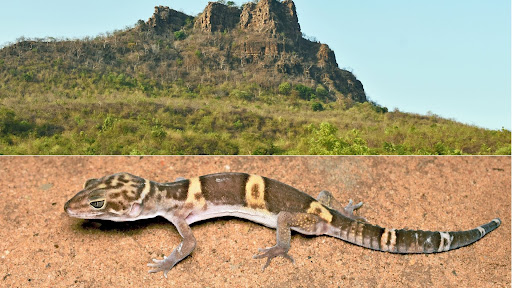
Scientists from the Zoological Survey of India have discovered a new species of leopard gecko from the rocky hills of Bihar, India. Found during a wildlife survey on the outskirts of the Kaimur Wildlife Sanctuary, the newly named Jhuma's leopard gecko (Eublepharis jhuma) is the first of its kind ever recorded in the state, with unique physical traits and distinct DNA.
A team of researchers from Zoological Survey of India, Wildlife Institute of India, Ravenshaw University, Fakir Mohan University, and others stumbled upon the elusive reptile while exploring the region’s tropical dry forests in October 2021. By examining the gecko's physical features and analysing its mitochondrial DNA, the scientists realised they had found a new evolutionary lineage. The genetic data showed that this gecko separated from its closest relatives millions of years ago, likely shaped by the ancient geological movements of the Indian subcontinent.
Jhuma’s leopard gecko has several unique characteristics that make it stand out from its closest relatives. Reaching about 14 centimetres in body length, this medium-sized reptile sports a dark brown back decorated with two pale, spotty bands. Unlike its closest known
relative, Eublepharis satpuraensis, this new species has large, flat, bumpy scales on its back with unusually wide gaps in between them. It also features a higher number of tiny, textured ridges, known as lamellae, underneath its fourth toe, which help with gripping. Furthermore, the gecko has a specific pattern of 12 to 13 pores near its tail, and if its tail drops and regrows, the new scales grow back in a distinct, flat, and rectangular shape rather than a circular one.
The research team decided to name the new reptile in honour of Dr Dhriti Banerjee, the first female director of the Zoological Survey of India, nicknamed Jhuma. The team chose it to celebrate her significant contributions to the study and conservation of India's vast animal diversity. Leopard geckos are highly sought after in the international pet trade, but wild populations are remarkably understudied and face mounting threats from habitat loss, agricultural expansion, and illegal smuggling. The researchers hope that uncovering Jhuma’s leopard gecko will shine a spotlight on the Kaimur Plateau as an overlooked hotspot for rare wildlife, prompting stronger conservation efforts to protect the region's unique and vulnerable ecosystems.