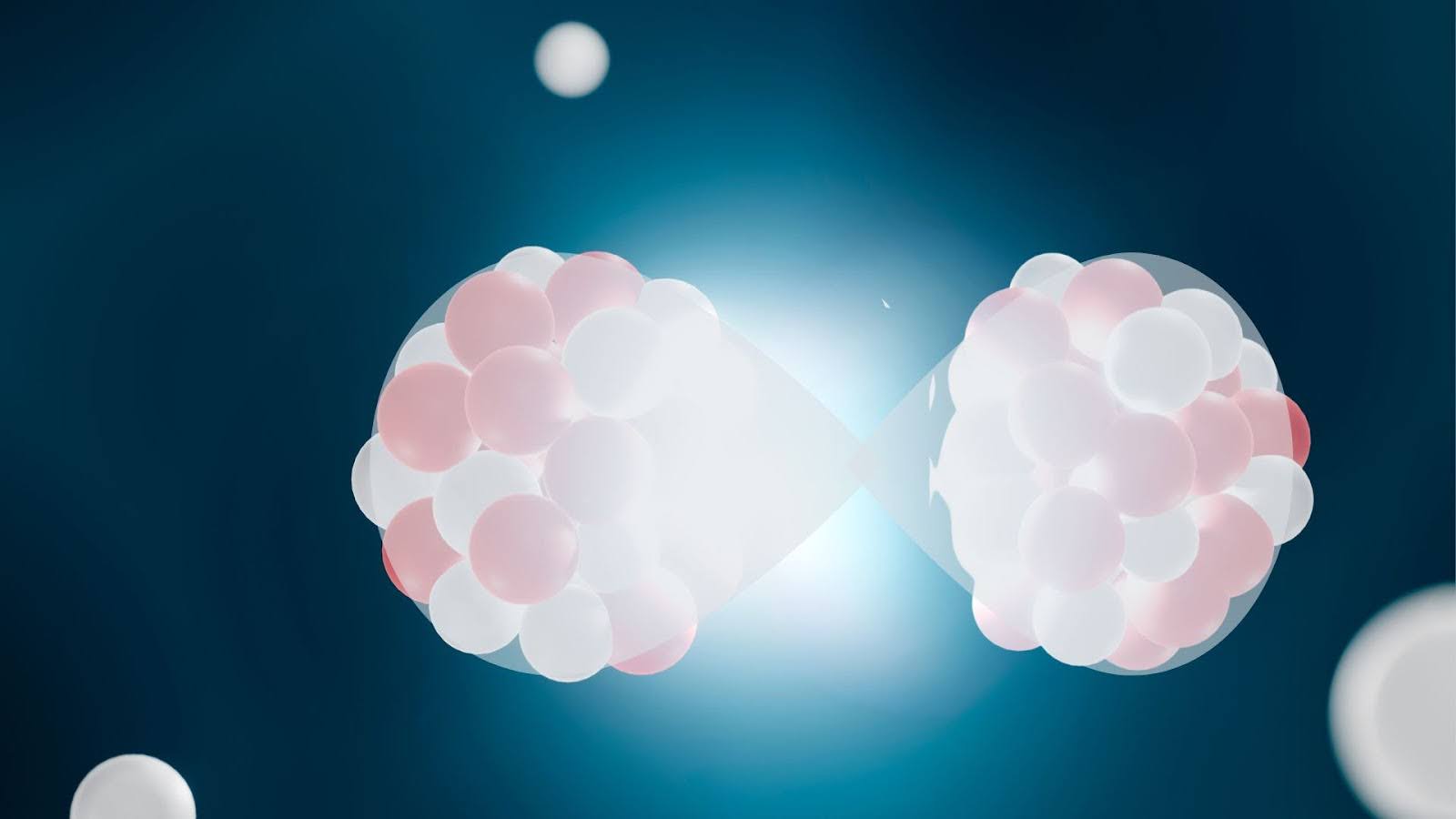
Scientists have uncovered new details about the violent final moments of nuclear fission, observing rare showers of protons that occur exactly as an atom’s nucleus snaps in two. The research, conducted at the BARC-TIFR Pelletron LINAC Facility in Mumbai, provides a fresh look at the neck rupture process, a split-second event that has long been of interest to nuclear physicists. By tracking charged particles, the team has observed the dynamics of nuclear matter under extreme conditions, offering clues to the fundamental forces that hold the matter together.
Nuclear fission is a process where the nucleus of a heavy atom (such as uranium-235 or plutonium-239) splits into two or more smaller nuclei, releasing enormous amounts of energy, gamma rays, and neutrons. It is often compared to a stretching drop of liquid that develops a thin neck before breaking into two smaller droplets. While this process is well understood in low-energy environments, such as those found in traditional power plants, the physics changes when atoms collide with heavy ions at high speeds. In these high-heat scenarios, the researchers found that the neck of the nucleus behaves more like a thick, honey-like fluid than a watery one. This property, known as nuclear viscosity, appears to change significantly as temperature rises, making the nucleus more viscous and slowing the eventual snap.
The breakthrough came from the team’s ability to disentangle different types of particle emissions. During fission, the nucleus releases various particles, such as protons, neutrons, neutrinos, and photons. The researchers focused on the positive protons, specifically those emitted from two locations: the poles (along the direction of fragment motion) and the equator (perpendicular to the split). This marks the first time that polar proton emissions have been clearly identified and separated in heavy-ion-induced fission. These protons carry information about the state of the nucleus at the exact moment of scission, or the break, and allow researchers to study the moments just before and after the fission.
In the past, it was difficult to tell if a particle was released before the nucleus split, during the split, or from the fragments after they had already flown apart. The new study successfully isolated these scission-point particles from the noise of other emissions. The team used a technique called Moving Source Disentangling Analysis to categorise the particles and their point of origin correctly. Using this method, the team demonstrated that a specific fraction of the protons produced during fission originates from the nucleus's deformation. The number of protons was nearly four times higher than expected when compared to other particles like alphas.
The study helps us understand one of the fundamental forces of nature, potentially leading to safer and more efficient methods for harnessing nuclear energy toward a carbon-free future. It also helps scientists predict how to create super-heavy elements, man-made atoms that don’t exist in nature. Furthermore, by mastering the viscosity of nuclear matter, we gain a better understanding of stellar life cycles and the fundamental forces of the subatomic world.