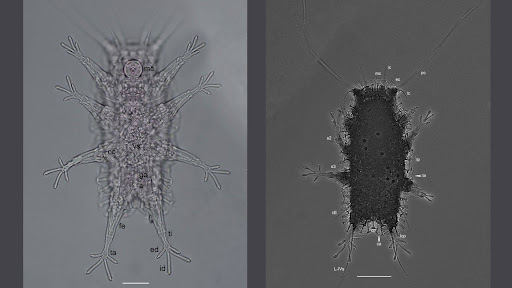
Scientists have discovered a new species of tardigrade, fondly known as the marine water bear, off the northeast coast of India. This marks the first time in 43 years that a new member of its elusive genus has been found. An international team, including researchers from CSIR-National Institute of Oceanography, the University of Minho, Portugal, and the Academy of Scientific and Innovative Research (AcSIR), discovered the microscopic creature in the shallow marine waters of the Bay of Bengal. Found near the coastal region of Markandi in Odisha, the new tardigrade has been officially named Actinarctus odissi. The naming pays homage to the creature's local roots, with odissi chosen to honour the famous traditional classical dance form originating from the state of Odisha, where the tiny animal was unearthed.
The researchers collected sand samples from the ocean floor at a depth of 14 metres. They used a tool called a Van Veen grab, which is a mechanical scoop used to collect sediment and sludge samples from the beds of lakes, rivers, and oceans, which was deployed from a local fishing trawler. Back in the laboratory, the team used a decantation method, washing and filtering the sandy sediment through a series of incredibly fine microscopic sieves, to separate the tiny marine life from the sand. Under a microscope, they handpicked the tardigrades with a very fine brush before mounting them on glass slides for closer study.
Tardigrades are famous worldwide for their resilience, ability to survive harsh environments, and pudgy, bear-like appearance. The Actinarctus odissi, however, looks quite alien, even by water bear standards. The creature boasts a dome-shaped body surrounded by transparent, wing-like flaps called alae, which are supported by translucent pillars. By examining it under a microscope, the team noticed several unique characteristics that easily differentiate it from its closest relatives. While other species in this genus feature long wings and elaborate internal supports, this new water bear has noticeably shorter lateral wings. Furthermore, its back legs possess simple, un-split sensory organs that are much shorter than those of its cousins. It also features blunt-tipped sensory appendages, rather than sharp ones, and its back is uniquely heavily sculptured with tiny, trombone-shaped pillars.
Finding a new marine tardigrade is a rare and exciting event for biologists. While there are over 1,500 known species of tardigrades worldwide, their marine counterparts are surprisingly understudied, accounting for only about 17%of total tardigrade diversity. For the Actinarctus genus specifically, no new species had been described anywhere in the world since 1982. This tiny discovery represents a massive leap in our understanding of marine micro-animals, highlighting the vast, undiscovered biodiversity hiding in the sands of the Indian Ocean.