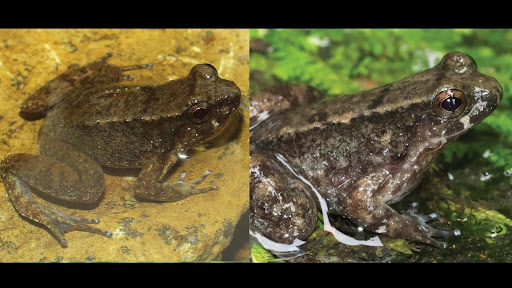
A researcher has discovered a new species of frog in the canopy-covered streams of northeastern India. Researcher R. S. Naveen from Australia's Griffith University officially identified the western trickle frog or Ingerana occidens in the Garo and Khasi Hills of Meghalaya. By comparing the physical characteristics and DNA of frogs separated by the massive Brahmaputra River during field surveys between 2024 and 2025, Naveen proved that what was once thought to be a single, widespread frog species is actually two completely different ones.
The discovery stemmed from a hunch about geography. The mighty Brahmaputra River acts as a giant natural wall, a well-known biogeographic barrier that prevents animals on either side from mixing and interbreeding. Suspecting this physical barrier might have allowed isolated frog populations to evolve independently over time, Naveen ventured out into the forests at night to collect and study specimens. When he compared the DNA of the newly found southern frogs to the topotypic Ingerana borealis frogs living north of the river, he uncovered an 18% difference in their genetic code. Such a massive genetic gap is usually considered enough to confirm that the southern frogs belong to a distinct and previously undocumented species.
The newly discovered western trickle frog is noticeably smaller, with adult females reaching just 26 millimetres in length. While its northern relative is heavily wrinkled, the new frog features mostly smooth skin with only mild wrinkling and boasts a distinct stripe of contrasting colour running down its side. Perhaps its most noticeable feature is its clearly visible, protruding eardrum, known as a tympanum, topped by a strong fold of skin. In contrast, the northern species has practically invisible eardrums.
The new amphibian was officially named Ingerana occidens. The species name occidens is derived from the Latin word for 'west'. This name was chosen because the frog's habitat marks the westernmost known range of any species in its genus. Finding such a widespread and distinctly different frog in a region that scientists have already explored heavily for decades was a major surprise. It highlights how much of our planet's incredible biodiversity remains undocumented, and how much more there is to learn about the natural world right beneath our feet.