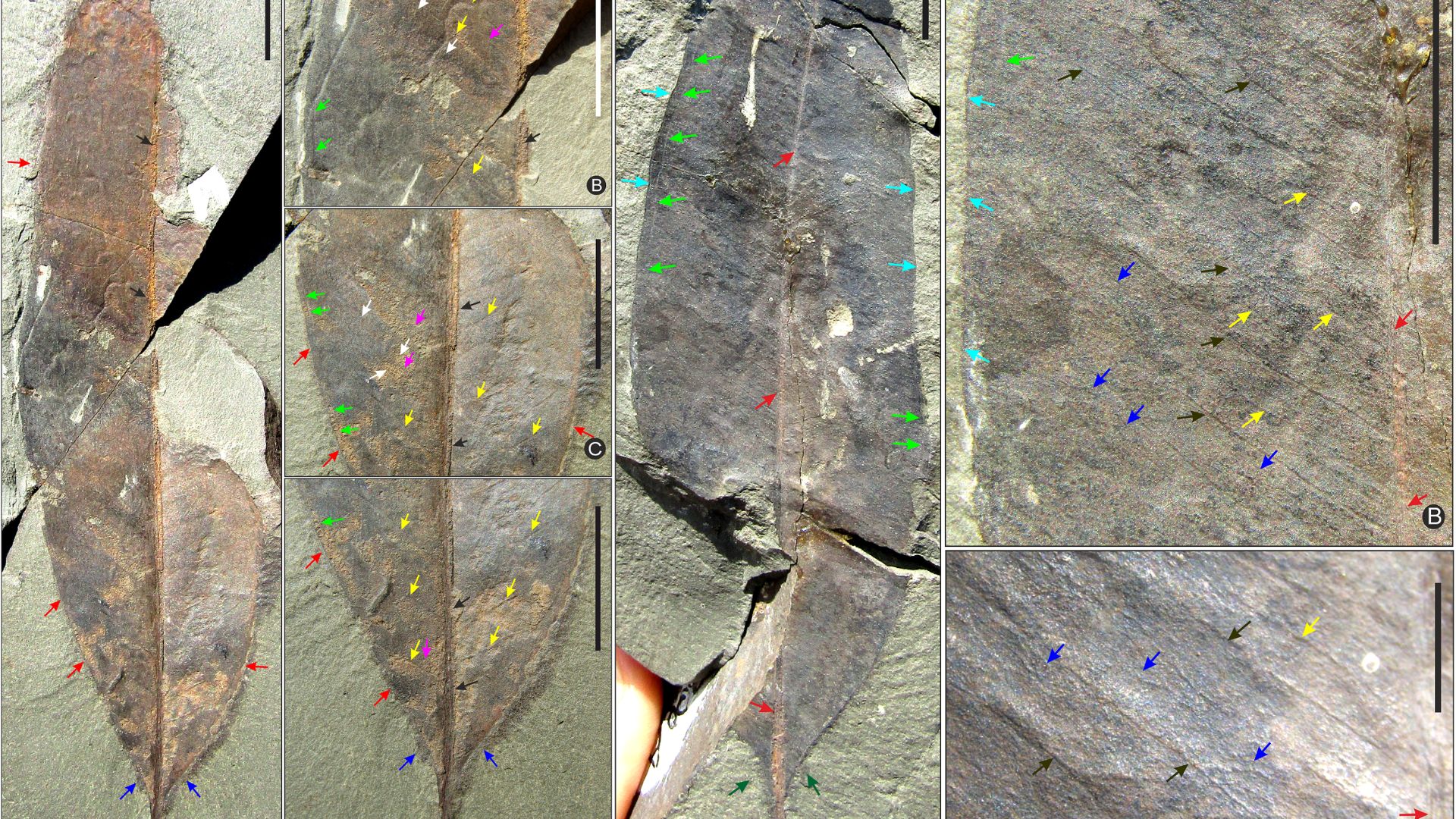
Scientists have unearthed a remarkably well-preserved 20-million-year-old fossil leaf in the foothills of the Himalayas, revealing a new, now extinct plant species. The fossil belongs to Syzygium, a genus of flowering trees and plants with over 1,200 species today, including the modern clove plant. It was discovered in the Kasauli Formation in Solan District in Himachal Pradesh by a team of palaeobotanists from the Birbal Sahni Institute of Palaeosciences, Academy of Scientific and Innovative Research (AcSIR), and Tribhuvan University, Nepal.
The discovery of this fossil in sediments from the Early Miocene, a period 20 to 5 million years ago, provides evidence that these plants were thriving in India tens of millions of years ago. This challenges the conventional belief that the genus originated exclusively in Australia or Southeast Asia, potentially changing our understanding of how tropical forests evolved on the Indian subcontinent.
The research team carefully dug out eleven fossilised specimens from the greenish-grey shale rock using chisels and hammers. Because organic material like the plant's waxy outer skin rarely survives over millions of years, the scientists could not rely on DNA or cellular structures to identify the plant. Instead, they photographed the fossils under microscopes and used a mathematical method called hierarchical cluster analysis. By comparing 22 distinct physical characteristics of the fossil leaves against 156 different species of modern plants, the software helped the team confidently match the ancient leaf to its correct place on the evolutionary tree.
The visual analysis suggested they had found a new species. The new fossil stands out from previously discovered ancient leaves because of a unique combination of physical traits. It features a narrow, perfectly symmetrical oval-like shape, a straight-to-convex base, a distinctively long stem, and a complex, random net-like pattern of tiny veins running between the larger structural veins. Because its size, shape, and vein patterns almost match those of a modern counterpart, Syzygium salicifolium, the researchers officially named the newly discovered extinct species Syzygium paleosalicifolium to honour its closest living relative.
For years, the Syzygium genus has been something of a mystery, with conflicting DNA studies suggesting it originated in the Australia-New Guinea region around 51 million years ago. However, this new discovery in the Himalayas, combined with the team's re-examination of other older Indian fossils, proves the plants were present in India as far back as the early Eocene epoch. This means the genus likely originated on the ancient supercontinent of Gondwana and diversified much earlier than previously thought, hitching a ride on the Indian landmass as it drifted across the prehistoric ocean before colliding with Asia, and spreading through the rest of the continent. By piecing together these ancient leafy relics, scientists are solving a prehistoric geographical puzzle, and also gaining a much deeper understanding of how our modern tropical ecosystems survived shifting continents and changing climates to become the forests we know today.