An international team of scientists has unearthed a well preserved, 52-million-year-old fossilised flower in a western Indian lignite mine. The discovery reveals an ancient connection between the Indian subcontinent and its southern neighbour, Australia. The discoverey was made by a collaborative team of researchers from Sidho-Kanho-Birsha University,West Bengal, Life Sciences Museum, South Africa, Chinese Academy of Sciences, China, The Open University, UK, and others.
The delicate fossilised blossom was found in the Gurha opencast lignite mine in Bikaner, Rajasthan. The sediments here are believed to be from the Early Eocene period, approximately 56 to 33.9 million years ago. This find marks the first fossil record of the plant genus Backhousia, ever discovered outside of the Australian continent. The genus Backhousia is a group of trees and shrubs in the myrtle family, a common flowering plant, and was previously thought to be unique and endemic to Australia.
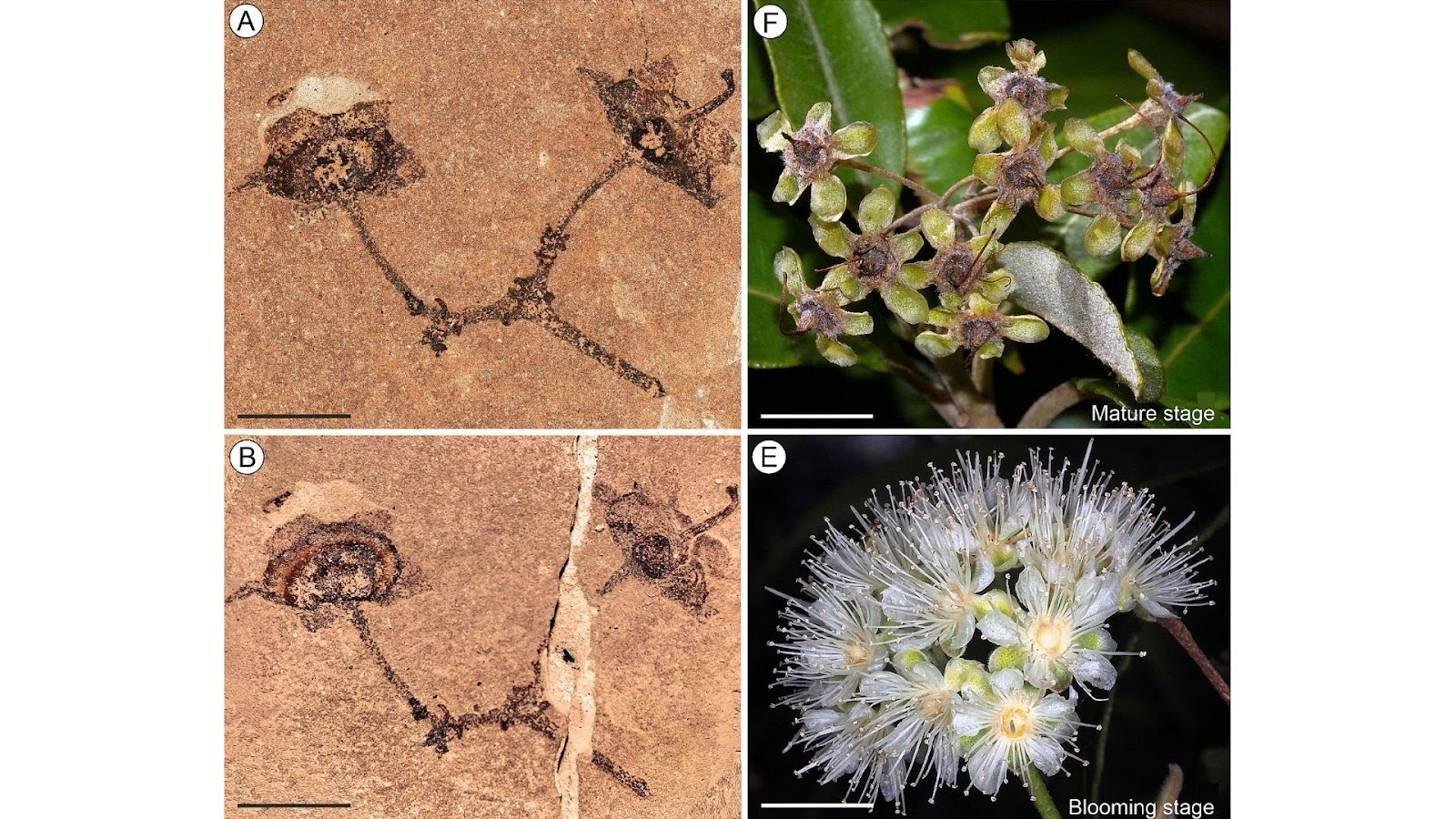
The researchers discovered the ancient blossom by excavating thin, laminated layers of maroon shale from a Paleocene-Eocene era geological feature called the Palana Formation within the Gurha mine. The team microscopically studied the fossil's physical traits and ran evolutionary computer models, comparing the ancient flower to a wide variety of both modern and fossilised plants.
While the ancient flower shares some resemblance to its closest living relative, the modern lemon myrtle (Backhousia citriodora) found in the rainforests of Australia, it possesses a few distinct characteristics that set it apart. Most notably, the newly discovered fossil features unique triangular sepals (the leaf-like parts that enclose the flower bud) with sharp, acute points. In contrast, its modern cousin possesses oval to lance-shaped sepals with rounded edges. Furthermore, the fossil showcases a uniquely thickened, cup-shaped base called a hypanthium, topped with a circular nectar-producing gland, a single long style, and a globe-like ovary.
The presence of an Australian flower in an Indian mine could help in telling the geological story about the shifting of the Earth's continents. Around 500-600 million years ago, India, Australia, Zealandia, Antarctica, South America, and Africa were stitched together as part of a massive southern supercontinent called Gondwana. When this massive landmass fractured, India began a long, solitary drift northward across the ancient ocean before eventually colliding with Asia.
Finding this Backhousia blossom in a 52-million-year-old Indian rock shows that these myrtle plants could have already been thriving across Gondwana before the split. Instead of migrating across modern oceans, this little flower essentially rafted on the Indian subcontinent as it moved north. The discovery shows us that tropical rainforests once thrived in the now-arid region of Rajasthan. More importantly, it also provides evidence of the shared botanical heritage between two landmasses that are now thousands of miles apart.