Marine scientists have discovered a new species of snake eel lurking in the shallow waters of the Bay of Bengal. The new species, officially named Bascanichthys chepakakiensis, was unexpectedly found by researchers analysing the accidental bycatch of commercial fishing boats operating off the eastern coast of India. A collaborative team discovered researchers from the ICAR-National Bureau of Fish Genetic Resources, the Kerala University of Fisheries and Ocean Studies, and the Zoological Survey of India.
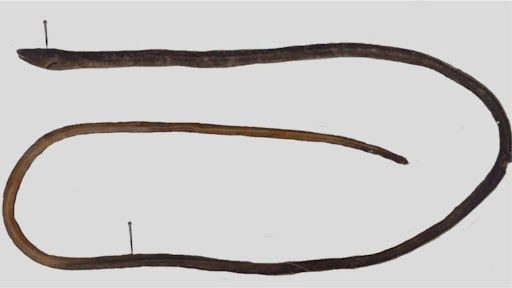
The team collected two specimens of this extremely long, slender fish. The first, a perfectly intact eel, was found at the Kakinada fishing harbour in Andhra Pradesh, caught in a trawl net dragged along the seafloor at depths of 30 to 50 meters. A second, slightly damaged specimen was later retrieved from the Arjyapalli fish landing centre in Odisha. By combining traditional physical measurements with modern DNA testing, specifically targeting the mitochondrial gene COI, the team confirmed they had discovered a new species.
Snake eels are known for their slender, snake-like bodies, but Bascanichthys chepakakiensis has several unique physical traits that set it apart from its closest evolutionary relatives. The eel features a distinct bicoloured body, fading from a pale brownish, light olive-grey on its back to a lighter belly, with a dusky dark brown snout. Compared with its closest known genetic relative, the Pacific species Bascanichthys ryukyuensis, the new eel has a noticeably shorter snout, a different tooth arrangement in its jaws, and fewer vertebrae before its anal fin. It also possesses incredibly tiny, flap-like pectoral fins that are barely visible. Furthermore, it differs from the only other snake eel of this genus found in Indian waters, Bascanichthys deraniyagalai, by having its dorsal fin closer to the front of its head, a much shorter tail, and a shorter snout.
When it came time to name their discovery, the researchers chose to honour the local culture and the exact location where the fish was found. The specific name, chepakakiensis, is a combination of two words from the regional Telugu language: chepa, which means "fish," and "kaki," a shortened nickname for Kakinada. In this harbour, the primary specimen was collected. Together, the name translates to "a fish from Kakinada."
This exciting find marks only the second time a species of this snake-eel genus has been described from Indian waters, ending a six-decade gap since the last local discovery. The finding pushes the global count of known Bascanichthys snake-eel species to 20, highlighting how much of our ocean's biodiversity remains hidden just beneath the surface, waiting to be discovered.