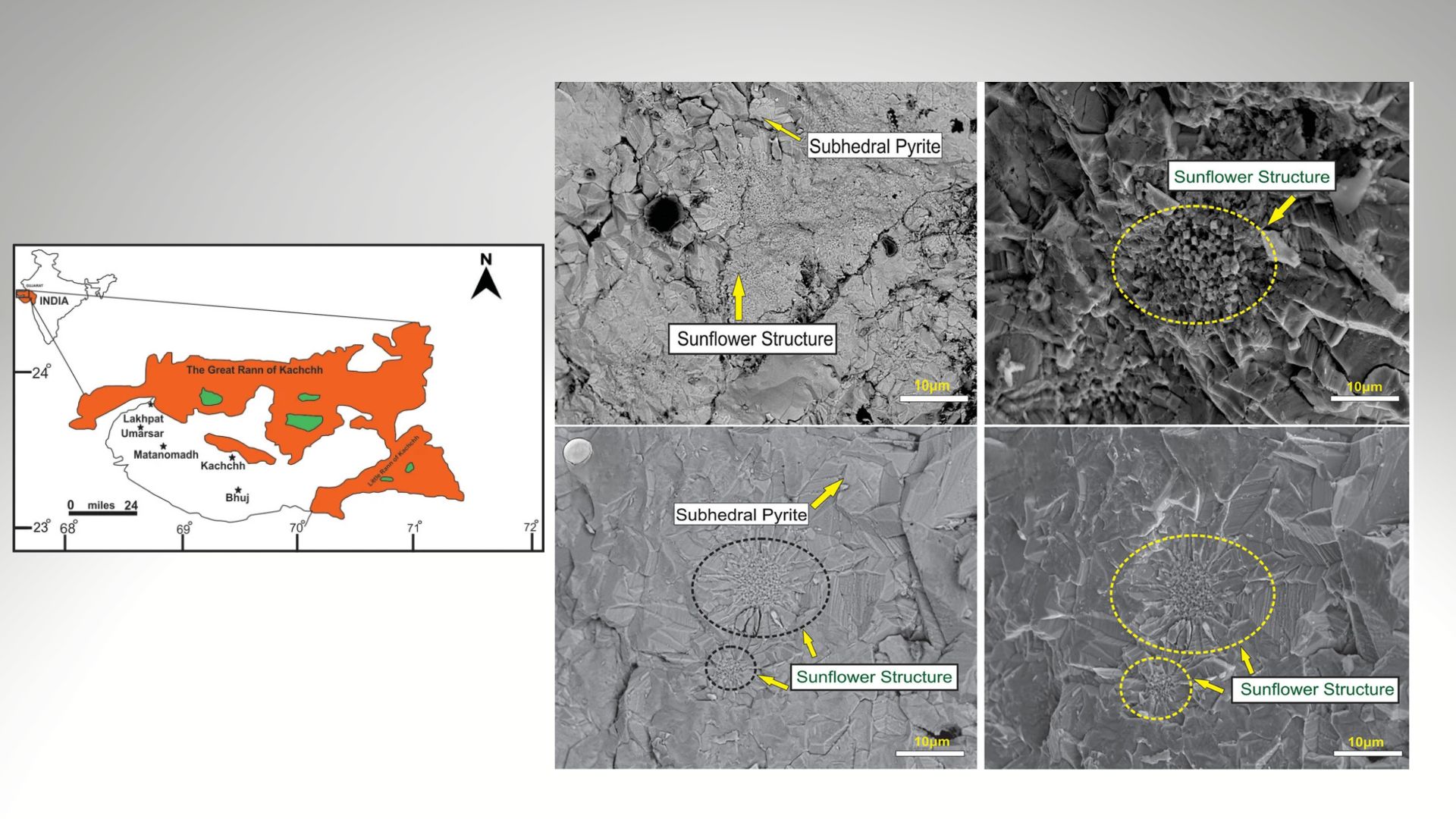
Geologists have discovered a rare, microscopic sunflower-shaped mineral, pyrite, commonly known as fool's gold, within the lignite coal reserves of Gujarat, India. The study, by researchers from Banaras Hindu University and the Indian Institute of Technology (Indian School of Mines) Dhanbad, marks the first report of this unusual mineral structure in India. By examining coal samples from the Matanomadh and Umarsar mines in western Kachchh, the team found that these unique mineral formations can help us understand ancient marine environments millions of years ago, while also serving as a stark warning for modern environmental safety and coal mining management.
The researchers collected coal pillars directly from the mines, carefully crushed them, and examined the dust under a Field-Emission Scanning Electron Microscope, which enabled them to zoom in on the complex, microscopic textures of the coal and reveal various shapes of pyrite. Most of the pyrite was framboidal, meaning it looked like tiny, tightly packed raspberries. However, among these raspberry shapes, the team spotted the exceptionally rare sunflower structure. This formation features a core of clustered micro-crystals surrounded by an outer ring of larger, flat crystals, remarkably resembling the dark seeds and bright petals of a sunflower.
The discovery provides a window into the ancient world. Millions of years ago, this region of India was an oxygen-starved, marshy coastal environment heavily influenced by the sea. In these swamps, sulfate-reducing bacteria broke down organic matter, releasing hydrogen sulfide. This gas reacted with iron in the water to rapidly form tight, spherical clusters of tiny framboid pyrite microcrystals. Over time, the conditions in the swamp began to change. The activity of sulfate-reducing bacteria slowed, resulting in less hydrogen sulfide being released into the environment. This environmental shift halted the rapid microcrystal growth. Instead, a slower process called recrystallisation began. Larger, flat, geometric crystals slowly grew around the outer rim of the framboid core, perfectly creating the distinct petals of the sunflower structure. The sunflower structure represents a rare transitional phase caught in time, in which a cluster of tiny raspberry-like pyrite seeds was just beginning to undergo chemical recrystallisation, growing an outer shell of solid crystal petals.
Finding these microscopic structures within the coal indicates that the pyrite is deeply embedded in the coal's organic matter. It is also remarkably difficult to clean the coal before it is used. The researchers note that standard methods of physical crushing or biological cleaning (beneficiation) to remove the sulfur simply will not be effective. In short, this coal is of very low quality and hard to purify. Because the sulfur is so difficult to extract, much of it remains in the coal when it is ultimately burned for energy. Burning sulfur-rich coal releases massive amounts of sulfur dioxide into the atmosphere. This gas is the primary cause of acid rain, which devastates forests, poisons waterways, and harms wildlife.
The tiny, fine-grained nature of the pyrite also acts as a chemical catalyst. The study notes that this type of pyrite reacts rapidly with oxygen, accelerating the coal's self-heating. This makes the coal highly prone to spontaneous combustion. This is incredibly dangerous for miners, as it can lead to sudden, uncontrollable underground fires, mine closures, and even fatalities.
By understanding the exact shape, size, and distribution of these pyrite sunflowers, mining engineers can better predict coal behaviour, design improved methods for filtering out toxic pollutants before the coal is burned, and safeguard both the lives of miners and the global environment from the dangers of sulfur-rich fossil fuels.