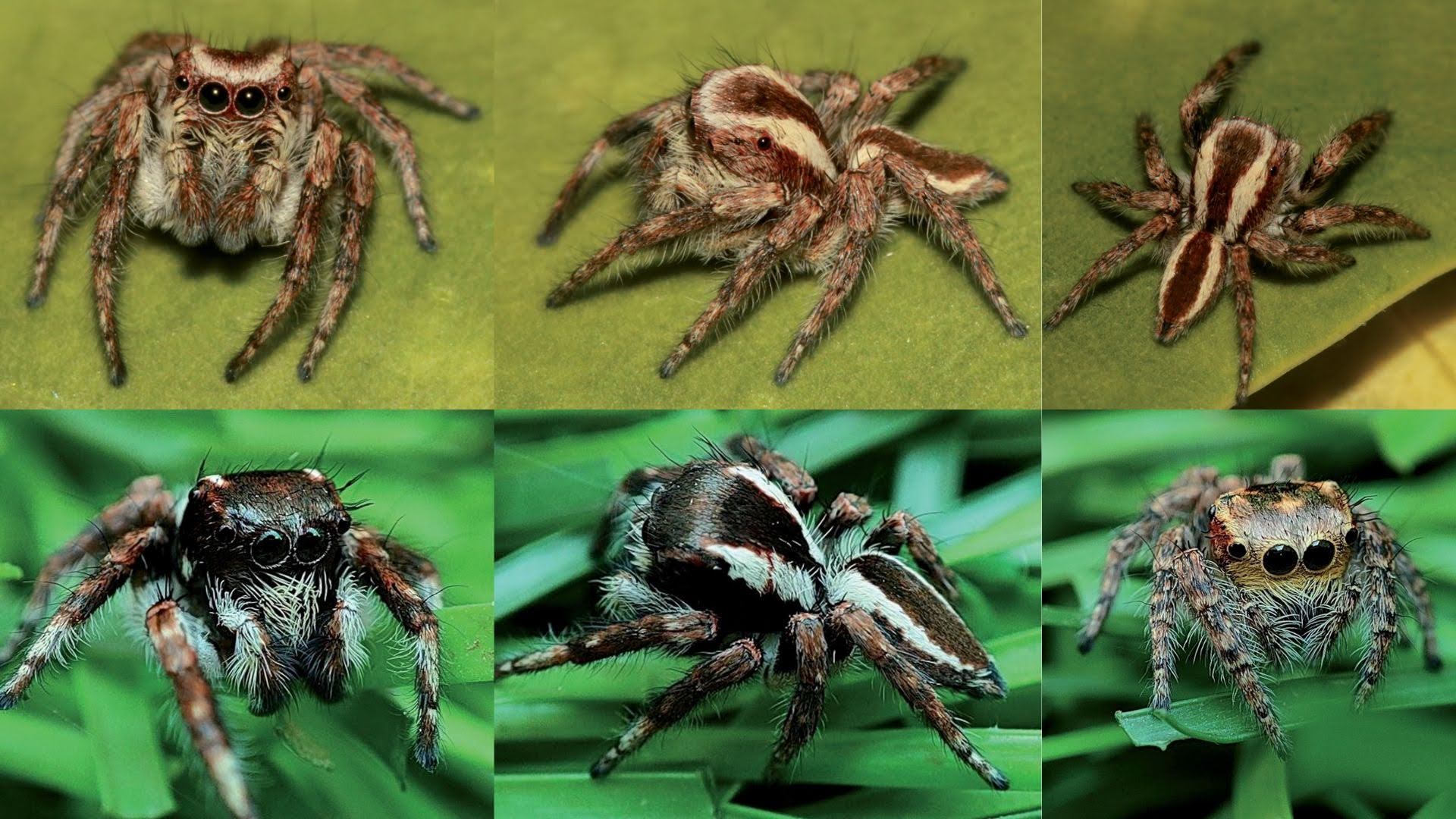
A team of scientists has discovered two new species of jumping spiders thriving in the country's drylands and urban green spaces. Uncovered during extensive field surveys across the semi-arid regions of Western India, these tiny, highly active spiders were found scurrying along tree branches and grasses. The research team from Christ College, Thrissur; Wildlife Conservation Trust; the Wildlife Institute of India; and others identified the new spiders by capturing them and examining them under microscopes to compare their anatomy with that of known species from around the world.
The two newly discovered arachnids belong to the genus Mogrus, a group of medium-sized jumping spiders typically found in the arid regions of Africa, Europe, and Asia. The first species was named Mogrus shushka. The specific name shushka is derived from a Sanskrit word meaning “dry" or "arid," a fitting title for a spider found navigating the harsh, dryland environments of Rajasthan and Gujarat. The second species, Mogrus pune, was discovered in the Alfa Laval Biodiversity Park in Maharashtra. It was named after the city of Pune to honour the small, urban protected areas that continue to harbour remarkable biodiversity despite the intense pressures of surrounding city life.
To prove these spiders were a new species, researchers had to examine their unique microscopic traits, specifically, their reproductive organs, which are unique to each species. Males of Mogrus shushka stand out from their closest relative, M. cognatus, by having a distinct triangular-shaped bump on their mating appendage, rather than a thumb-shaped one. The females feature a deep, semi-circular depression on their underside with short, closely spaced internal ducts. Meanwhile, both males and females of Mogrus pune share similarities with the spider M. mathisi. However, the male M. pune can be easily distinguished by a heart-shaped bump on its reproductive organ and uniquely curved structures, while the female possesses a distinctively wide and membranous central depression.
Alongside the discovery of these two new species, the researchers also made other exciting finds that expand our understanding of jumping spiders in South Asia. They recorded the presence of another spider, Mogrus larisae, in India for the very first time, and officially described the male of a previously known species, Mogrus rajasthanensis, which had only ever been identified by its females. Together, these discoveries highlight the incredibly rich and underexplored biodiversity of India's semi-arid ecosystems, proving that exciting scientific breakthroughs can be found everywhere from vast desert landscapes to local city parks.