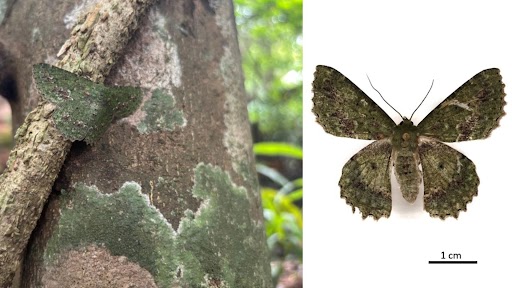
Scientists at the Kerala Forest Research Institute in India have observed a remarkable case of natural disguise. For the first time, they observed a relatively rare, vibrant green moth, Herochroma subspoliata, perfectly camouflaging itself against a specific type of pale green tree lichen in the humid forests of the Western Ghats. By mimicking the lichen's colour, pattern, and texture, the moth effectively vanishes into its background. Such camouflaging is a well-known evolutionary survival tactic that helps visually cryptic insects evade predators such as birds and lizards.
The research team made the observation during field studies on the Kerala Forest Research Institute's Peechi campus in Thrissur. They found a female moth resting flat against the bark of a native tree, which was heavily covered in a crusty, greenish-grey lichen Porina cf. tetracerae. The team also closely examined the insect's physical traits and compared them with the natural environment. They measured its 4.7-centimetre wingspan and studied its grass-green wings, noting the diffuse, intricate lines and serrated edges that disrupt the moth's outline. When viewed under magnification and compared directly with the lichen, the moth’s wing patterns remarkably mirrored the tiny irregularities, branching growths, and hues of the lichen patches.
This new observation also expands the known habitat of the relatively poorly documented moth species. Historically, confirmed sightings of this emerald moth were mostly restricted to high-altitude mountainous regions, usually above 1,000 metres above sea level, in places like northeastern India, Myanmar, and southern China. Finding the moth at an elevation of just 80 metres in the Western Ghats proves the species is far more adaptable than previously thought. Furthermore, while scientists have known for decades that moths use lichen for camouflage, pinpointing the exact species of lichen that this specific moth relies on adds a crucial new puzzle piece to our growing understanding of evolutionary biology and insect ecology.
However, it is important to note that, because these observations are based on field sightings, what appears to be perfect camouflage to the human eye might be perceived quite differently by the wild animals that interact with the moth. Our human visual limitations can sometimes bias how we interpret animal disguises, meaning bird or lizard predators might see light spectrums or patterns we cannot detect. Further behavioural experiments are needed to prove just how effectively this camouflage actually prevents predator attacks in a natural setting.
The vanishing act of this emerald moth once again highlights the importance of camouflage in evolutionary biology. Over countless generations, the constant threat of sharp-eyed predators has driven a quiet survival race, forcing the moth to adapt its appearance to perfectly mimic the lichen on which it rests. This relationship highlights ecological dependence, echoing the principles of co-evolution, in which the physical forms and survival strategies of different organisms become deeply intertwined over millions of years. Even though the lichen may not evolve specifically to hide the insect, the moth's entire existence has been uniquely sculpted by the presence of this living canvas and the visual pressures of the food web. Studying these complex survival strategies provides society with a much deeper understanding of how the natural world adapts and survives. It once again reminds us of the deeply connected living landscapes that have shaped life on Earth.