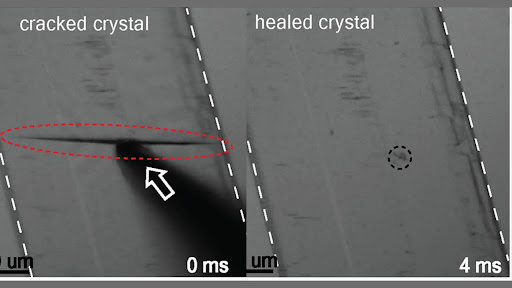
A team of researchers has discovered a unique mechanism in molecular crystals that allows them to automatically heal deep cracks in just a few milliseconds. The team, including researchers from the Indian Institute of Science Education and Research (IISER) Kolkata, the Indian Institute of Science (IISc), the Indian Institute of Technology (IIT) Indore, and CSIR-National Chemical Laboratory, discovered a precise way to produce self-healing materials. They found that applying physical stress to certain crystals causes them to crack. But, the moment the pressure is released, the broken halves snap back together, leaving little to no trace of the damage. This rapid, self-guided repair happens because the physical stress temporarily alters the crystal's microscopic symmetry, creating a force that pulls the broken pieces back into perfect alignment.
To understand this phenomenon, the team placed a lab-grown organic crystal called 2-methyl-4-nitroimidazole (MNI) under specialised microscopes and poked it with a tiny metal needle. The crystals of MNI possess centrosymmetry, meaning molecules are packed symmetrically around a central point. When the needle is pushed into the crystal, it deforms due to stress-induced symmetry breaking. However, they observed that the crystal did not shatter like typical glass. Instead, the crack stopped spreading halfway through. Using lasers and a technique called Raman spectroscopy, the scientists zoomed in on the molecular level to uncover why this happens.
The crystal they used is built in stacked sheets, much like a microscopic deck of cards. Normally, the structure is perfectly symmetrical. However, when the needle forces the sheets apart, this perfect symmetry is broken at the crack's surface. This sudden structural distortion generates a temporary electrical attraction between the split surfaces. At the same time, the tip of the crack slightly bends rather than breaking cleanly, acting like a miniature shock absorber. When the scientists removed the needle, the temporary electrical charges rapidly pulled the flexible layers back together, restoring the bonds and the crystal's original symmetry in less than a hundredth of a second.
In the past, creating self-healing materials often meant relying on soft, rubbery materials such as polymers or hydrogels. While some hard crystals have been known to self-heal, they almost always require an external trigger, such as intense heat, light, or a chemical bath, to stitch themselves back together. Even the few crystals previously known to heal autonomously were limited to specific types that naturally lack internal symmetry. This new research proves that highly ordered, symmetrical crystals can also achieve autonomous, ultrafast healing without any outside help, bridging a crucial gap between mechanical hardness and flexible self-repair.
The researchers, however, note that while the crystal is highly efficient at repairing hairline fractures and deep cracks, applying a massive, overwhelming force will still permanently shatter the material into separate fragments. Although these broken pieces show a slight attractive force to one another, they cannot fully reassemble once completely separated from the main body. Furthermore, the temporary electrical charges that drive the healing process are so small and short-lived that standard laboratory force sensors could not directly measure them, leaving scientists to rely on secondary optical laser tests to confirm their presence.
Nevertheless, the ability to engineer hard, crystalline materials that can instantly repair themselves holds tremendous promise for modern society. As our daily lives become increasingly reliant on miniaturized electronics, the tiny components inside our smartphones, computers, and medical devices remain highly vulnerable to physical shocks and daily wear and tear. Incorporating self-healing molecular crystals into these technologies could lead to incredibly durable, sustainable devices that fix their own mechanical damage on the fly. This would not only drastically extend the lifespan of consumer electronics but also significantly reduce the global crisis of electronic waste, making the technology of tomorrow greener and far more resilient.
Editor's note: The article was edited to correct a factual error and ensure acuracy. We regret the error