Imagine a creature so small that dozens of them could fit on the tip of your finger and yet crafty enough to build its own armour by carefully selecting grains of sand from the ocean floor and glueing them together into a tiny shell. Sounds like science fiction? It is, in fact, real, and is happening every second right now in the coastal waters of India.
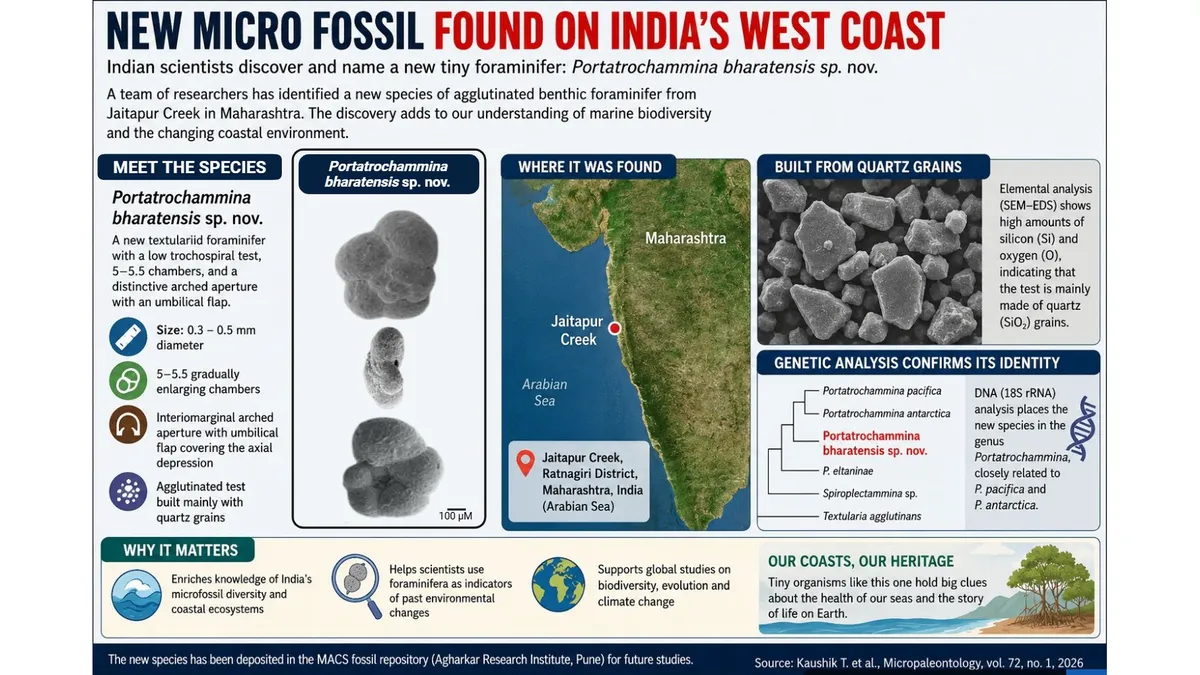
A team led by Dr Tushar Kaushik, Scientist at Agharkar Research Institute (ARI), Pune, has just announced the discovery of a new species of Foraminifera, a group of single-celled organisms that have inhabited the world’s oceans for over 500 million years. The new species, named Portatrochammina bharatensis, was found living in the sediments of Jaitapur Creek, a small estuary nestled along the Konkan coast of Maharashtra. The name “bharatensis” is a tribute to “Bharat,” the ancient name of India.
Foraminifera, or “forams” for short, are among the most abundant and ecologically important organisms in the ocean, yet most people have probably never heard of them. They are generally sand-grain size, measuring between 500 and 50 µm. Some foraminifera construct their intricate shells, called “tests,” from materials they scavenge from their surroundings (agglutinating mineral grains). Portatrochammina bharatensis is one among these master masons. It picks up tiny quartz sand particles and cements them together to create a robust outer test or shell. The new species is invisible to the naked eye, measuring only 0.3 to 0.5 millimetres across and is an integral part of coastal marine ecosystems. They recycle nutrients, serve as food for larger organisms, and their fossil shells are used by geologists to reconstruct past climates, date rocks, and even locate oil reserves.
The story of the discovery began in January 2023, when Dr Tushar Kaushik and Ms V. Dixit from ARI collected marine sediment samples from Jaitapur Creek, about 6 meters below the water surface. Jaitapur is a small coastal town in Maharashtra’s Ratnagiri district, bordered by mangrove forests, mudflats, and sandy beaches. It is also the site of a proposed nuclear power project, making its biodiversity particularly important to document.
In modern taxonomy, appearance alone is not enough. Many microscopic organisms look deceptively similar to one another, a phenomenon called “cryptic diversity.” To confirm that this was truly a new species, the team turned to molecular biology. They extracted DNA from sand-grain-sized individual specimens and sequenced the 18S ribosomal RNA gene, a biological barcode for species identification. The genetic analysis revealed that P. bharatensis is distinct from all known species. Phylogenetic trees, essentially family trees built from DNA data, placed the new species closest to two relatives: P. pacifica from the Pacific Ocean and P. antarctica from Antarctic waters. Despite this kinship, the Indian species is genetically and morphologically unique.
Dr Tushar Kaushik and team further explored the most fascinating aspects of P. bharatensis, which is the material it uses to construct its shell. Using a scanning electron microscope combined with energy-dispersive X-ray spectroscopy (SEM-EDS), the team discovered that the shell wall is composed predominantly of quartz. Quartz is one of the hardest and most chemically stable minerals on Earth. By selectively incorporating quartz grains into its test, this tiny organism effectively builds itself a suit of armour that can withstand the harsh, monsoon-driven chemical conditions of India’s west coast.
“This diminutive creature, no bigger than a grain of sand, yet equipped with a quartz shield and a genome that tells an evolutionary story spanning millions of years, serves as a powerful reminder: some of nature’s most remarkable innovations are hiding in plain sight, right beneath the waves,” says Dr Kaushik, Biodiversity & Palaeobiology Group, Agharkar Research Institute, Pune.
Every new species described adds a piece to the vast puzzle of Earth’s biodiversity. India has one of the longest coastlines in the world, yet its microscopic marine life remains vastly under-explored. The discovery of P. bharatensis underscores the importance of combining traditional microscopy with modern DNA techniques. It also signals that India’s estuaries and coastal waters likely harbour many more undiscovered species awaiting discovery and formal description.
“Understanding what lives in our coastal sediments is essential for environmental monitoring, pollution assessment, and conservation planning, especially at ecologically sensitive sites like Jaitapur,” Ms Vaishnavi Dixit, PhD Student, Biodiversity & Palaeobiology Group, Agharkar Research Institute, Pune
This article was written by Dr Tushar Kaushik, Researcher at Agarkar Research Institute, Pune.
Editor's Note: The story was updated with a better resolution image. The error is regretted.