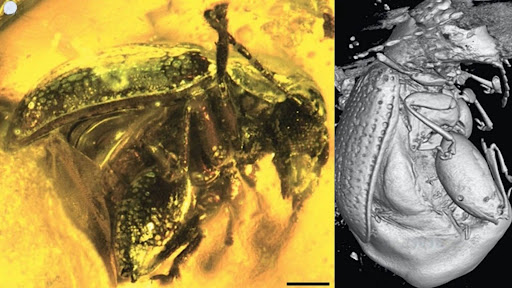
Researchers have discovered a microscopic new species of leaf beetle trapped in amber from the Kutch Basin in Gujarat. Dating back to the Middle Eocene epoch, a period roughly between 47.8 and 38 million years ago, the tiny insect was identified using three-dimensional X-ray technology. Named Cambaltica patra, this astonishingly well-preserved fossil offers researchers vital clues about the ancient tropical rainforests that once covered the region and how insects evolved during prehistoric periods of global warming.
A team made the discovery of researchers from DST Birbal Sahni Institute of Palaeosciences, Raja Ramanna Centre of Advanced Technology, and Christian-Albrechts University of Kiel, Germany. The team examined a small, translucent amber nodule, which is a clear yellow-brown fossilised tree resin, collected from the Umarsar Lignite Mine. Encased in the nodule was the prehistoric insect.
Measuring just 1.1 millimetres in length, the dark black beetle is one of the smallest fossil leaf beetles ever recorded. Because the insect is so exceptionally tiny and encased in fossilised tree resin, studying its delicate features with standard microscopes was highly challenging. To overcome this, the scientists employed a technique called synchrotron phase-contrast micro-computed tomography at the Indus-2 Synchrotron source at the Raja Ramanna Centre for Advanced Technology in Indore. By bombarding the amber with highly focused X-rays at a specialised facility, they were able to peer inside the solid resin without breaking it. This technology allowed them to generate highly detailed, three-dimensional digital models of the beetle, revealing microscopic traits like its distinct antennae, bulging eyes, and spiky legs.
The researchers determined that the insect belongs to the genus Cambaltica, marking only the second time a species from this genus has ever been identified. A detailed morphological analysis revealed several unique characteristics that clearly differentiate the new beetle from its closest known relative, Cambaltica paleoindica, which was previously found in older Cambay amber.
The newly discovered species features a longer first part of its hind legs called the metatarsomere, which is noticeably thinner and narrower at the apex. Furthermore, the outer edge of the middle section of its back leg or its hind tibia is equipped with a row of unusually long spines that extend for a third to half of the leg segment's total length. Unlike its predecessor, this new beetle also has a completely smooth pronotum, the armour-like shield just behind its head, rather than being covered in tiny pits or dents. Additionally, the front corners of this shield are thicker. The claws at the end of its feet are also simple and straight, without widening or bulging out at the bottom.
When it came to officially naming the discovery, the researchers chose to honour the insect's modern relatives and the rich linguistic history of India. They named the new species Cambaltica patra, deriving the specific epithet "patra" from the ancient Sanskrit word for "leaf." This name pays homage to the Chrysomelidae family, globally known to science and nature enthusiasts as the leaf beetles, to which this tiny, prehistoric survivor belongs.
While diverse insects have been found in Indian ambers before, leaf beetles from tropical regions are incredibly rare in the fossil record, with most extinct genera represented by only a single known species. Previously, scientists had discovered just one other species belonging to this specific genus, found in the older Cambay amber deposits nearby. Finding a second, closely related species in the much younger Kutch amber proves that this specific group of beetles survived in the Indian subcontinent for at least ten million years across different geological ages. This multi-species discovery shifts the scientific understanding of these ancient ecosystems, showing a clear biological link between the distinct amber deposits of Cambay and Kutch, which both originated from the resin of ancient lowland rainforest trees.