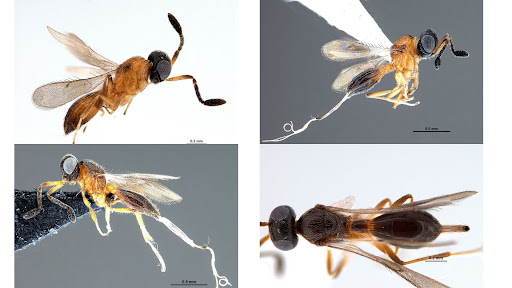
Researchers from the Zoological Survey of India and the University of Calcutta have discovered ten new species of tiny, parasitic wasps in the forests and farmlands of eastern and northeastern India. By setting out traps between 2021 and 2025, researchers captured the millimetre-long insects and used a combination of microscopes and DNA analysis to identify them. The discovery, which includes the first-ever DNA barcodes for this specific group of wasps, drastically expands our understanding of these ecologically important insects, which are likely helping control local cricket populations.
The research team collected the wasps across the states of Arunachal Pradesh, Assam, and West Bengal. To catch them, the team placed yellow pan traps, which are essentially bright yellow bowls filled with liquid that naturally attract flying insects, in various environments. They then preserved the specimens and examined them using scanning electron microscopes. They identified the tiny creatures, which measure just 1 to 2 millimetres in length, as belonging to the genus Duta.
To tell these new species apart from their known relatives, the researchers looked at the finer details. Previous studies usually focused on the texture of the top of the wasps' heads or the proportions of their wing veins. However, this team focused heavily on pleural characters, the unique ridges, grooves, and textures found on the sides of the wasps' bodies. For example, some of the newly discovered wasps differ from their closest cousins by having entirely smooth sides, while others feature complex, pitted grooves or unique, tiny bumps on their abdomens. To confirm their findings, the team also extracted the wasps' DNA to create genetic maps, proving definitively that these were distinct, never-before-recorded species.
The 10 new species recorded are Duta coriata, Duta foveola, Duta microphleba, Duta obscura, Duta pallida, Duta procera, Duta protuberata, Duta semiannulata, Duta succina, and Duta xantha. The scientific names given to these new wasps offer a clever clue to their unique physical appearances. Duta coriata, for instance, gets its name from the Latin word corium, meaning leathery, because of the tough, textured surface of its head. Another species, Duta protuberata, is named after the Latin word for protuberance, referring to a unique, smooth bump on its first abdominal segment. Others are named for their striking colours, such as Duta succina, meaning 'amber-coloured' in Latin, and Duta xantha, derived from the Greek word for 'yellow'.
Though much of their life cycle remains a mystery, biologists believe these tiny wasps are parasitic. They lay their eggs inside the eggs of ground crickets. When the wasp larvae hatch, they consume the cricket egg from the inside out, making them a fascinating and potentially vital part of the local ecosystem's food web.
“These parasitoid wasps play an important ecological role by helping regulate ground cricket populations in natural ecosystems,” remarks Rupam Debnath, the lead author of the study.
Before this study, only seven species of Duta wasps had been recorded in India, and they were mostly found in the southern part of the country. This new research not only more than doubles that number but also proves that these wasps are widespread across India's northern and eastern regions.