Supernovae
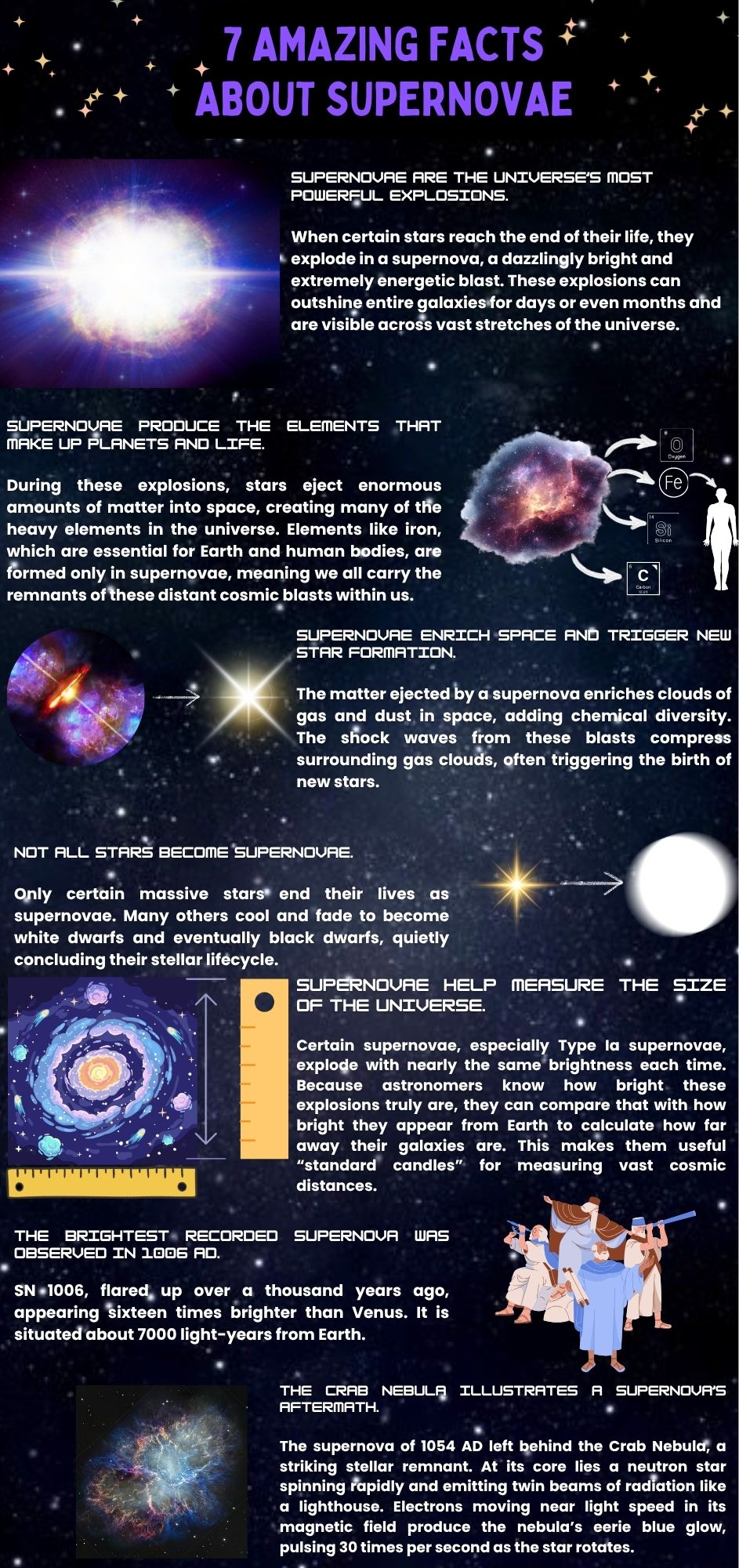
Supernovae are the universe’s most powerful explosions.
When certain stars reach the end of their life, they explode in a supernova, a dazzlingly bright and extremely energetic blast. These explosions can outshine entire galaxies for days or even months and are visible across vast stretches of the universe.
Supernovae produce the elements that make up planets and life.
During these explosions, stars eject enormous amounts of matter into space, creating many of the heavy elements in the universe. Elements like iron, which are essential for Earth and human bodies, are formed only in supernovae, meaning we all carry the remnants of these distant cosmic blasts within us.
Supernovae enrich space and trigger new star formation.
The matter ejected by a supernova enriches clouds of gas and dust in space, adding chemical diversity. The shock waves from these blasts compress surrounding gas clouds, often triggering the birth of new stars.
Not all stars become supernovae.
Only certain massive stars end their lives as supernovae. Many others cool and fade to become white dwarfs and eventually black dwarfs, quietly concluding their stellar lifecycle.
Supernovae Help Measure the Size of the Universe.
Certain supernovae, especially Type Ia supernovae, explode with nearly the same brightness each time. Because astronomers know how bright these explosions truly are, they can compare that with how bright they appear from Earth to calculate how far away their galaxies are. This makes them useful “standard candles” for measuring vast cosmic distances.
The brightest recorded supernova was observed in 1006 AD.
SN 1006, flared up over a thousand years ago, appearing sixteen times brighter than Venus. It is situated about 7000 light-years from Earth.
The Crab Nebula illustrates a supernova’s aftermath.
The supernova of 1054 AD left behind the Crab Nebula, a striking stellar remnant. At its core lies a neutron star spinning rapidly and emitting twin beams of radiation like a lighthouse. Electrons moving near light speed in its magnetic field produce the nebula’s eerie blue glow, pulsing 30 times per second as the star rotates.