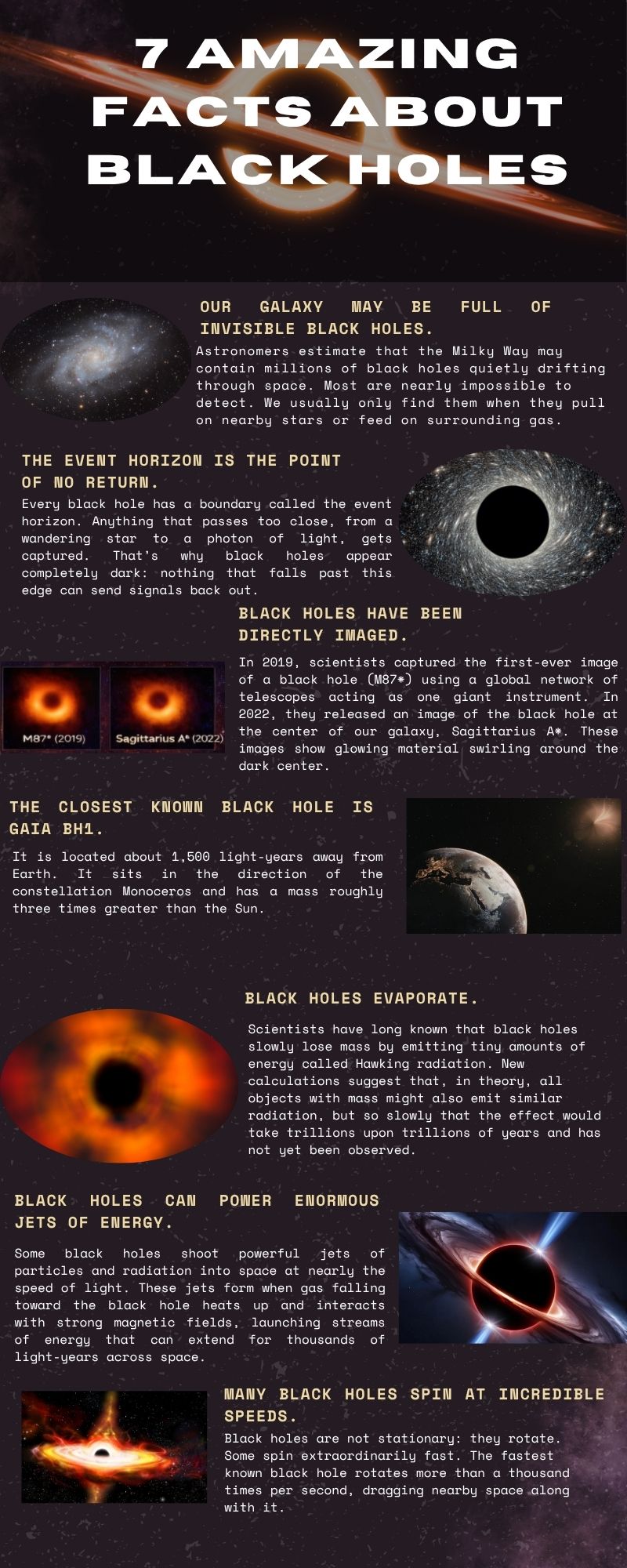
Our galaxy may be full of invisible black holes. Astronomers estimate that the Milky Way may contain millions of black holes quietly drifting through space. Most are nearly impossible to detect. We usually only find them when they pull on nearby stars or feed on surrounding gas.
The event horizon is the point of no return. Every black hole has a boundary called the event horizon. Anything that passes too close, from a wandering star to a photon of light, gets captured. That’s why black holes appear completely dark: nothing that falls past this edge can send signals back out.
Black holes have been directly imaged. In 2019, scientists captured the first-ever image of a black hole (M87*) using a global network of telescopes acting as one giant instrument. In 2022, they released an image of the black hole at the centre of our galaxy, Sagittarius A*. These images show glowing material swirling around the dark centre.
The closest known black hole is Gaia BH1. It is located about 1,500 light-years away from Earth. It sits in the direction of the constellation Monoceros and has a mass roughly three times greater than the Sun.
Black holes evaporate. Scientists have long known that black holes slowly lose mass by emitting tiny amounts of energy called Hawking radiation. New calculations suggest that, in theory, all objects with mass might also emit similar radiation, but so slowly that the effect would take trillions upon trillions of years and has not yet been observed.
A Black Hole Released Material Years After Destroying a Star. Astronomers observed a black hole that tore apart a star and then, unexpectedly, released bursts of material years later. Normally, most of the activity happens soon after a star is destroyed, but this event showed that black holes can remain active much longer than expected, continuing to eject matter long after the initial destruction.
Many black holes spin at incredible speeds. Black holes are not stationary: they rotate. Some spin extraordinarily fast. The fastest known black hole rotates more than a thousand times per second, dragging nearby space along with it.