Dark Matter
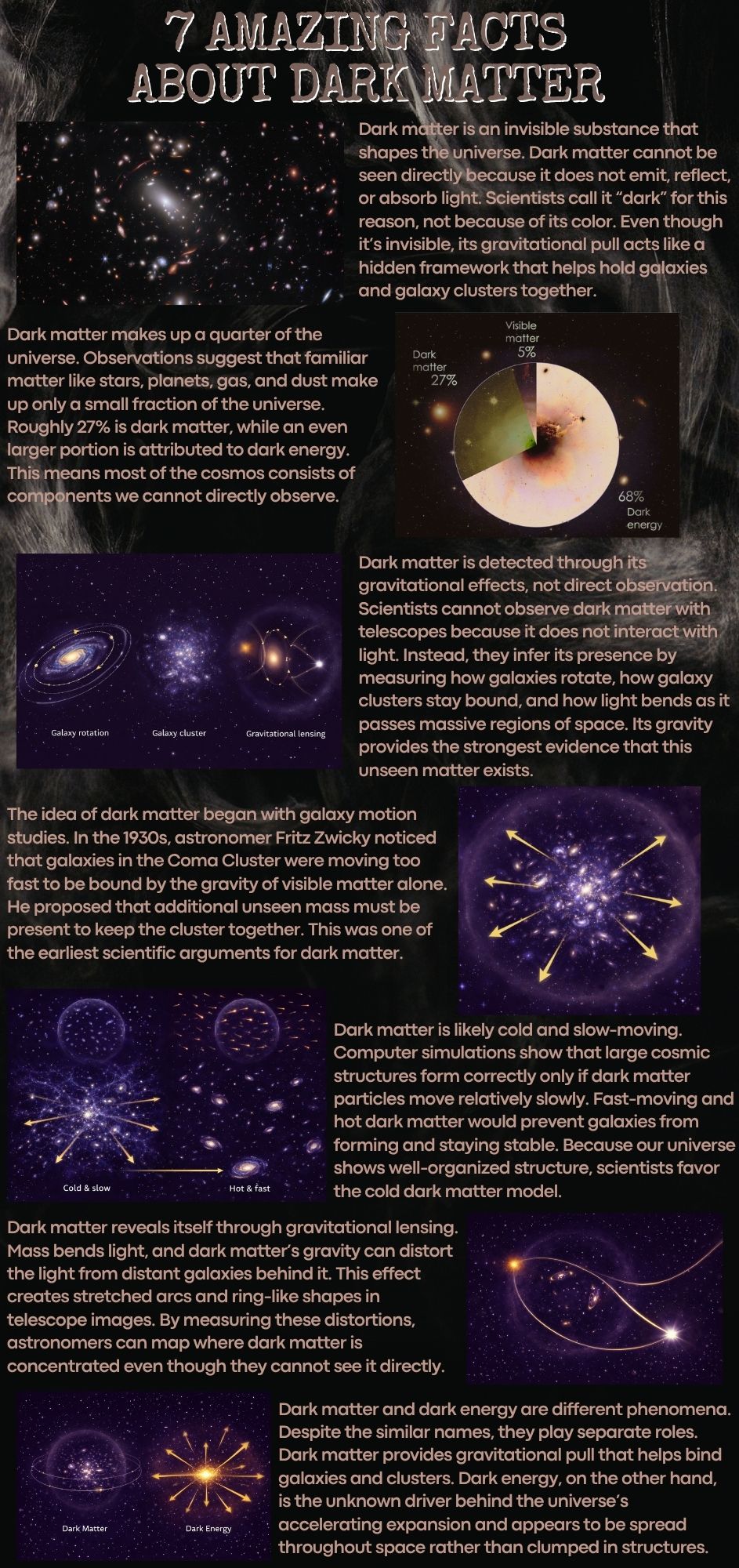
Dark matter is an invisible substance that shapes the universe.
Dark matter cannot be seen directly because it does not emit, reflect, or absorb light. Scientists call it “dark” for this reason, not because of its color. Even though it’s invisible, its gravitational pull acts like a hidden framework that helps hold galaxies and galaxy clusters together.
Dark matter makes up a quarter of the universe.
Observations suggest that familiar matter like stars, planets, gas, and dust make up only a small fraction of the universe. Roughly 27% is dark matter, while an even larger portion is attributed to dark energy. This means most of the cosmos consists of components we cannot directly observe.
Dark matter is detected through its gravitational effects, not direct observation.
Scientists cannot observe dark matter with telescopes because it does not interact with light. Instead, they infer its presence by measuring how galaxies rotate, how galaxy clusters stay bound, and how light bends as it passes massive regions of space. Its gravity provides the strongest evidence that this unseen matter exists.
The idea of dark matter began with galaxy motion studies.
In the 1930s, astronomer Fritz Zwicky noticed that galaxies in the Coma Cluster were moving too fast to be bound by the gravity of visible matter alone. He proposed that additional unseen mass must be present to keep the cluster together. This was one of the earliest scientific arguments for dark matter.
Dark matter is likely cold and slow-moving.
Computer simulations show that large cosmic structures form correctly only if dark matter particles move relatively slowly. Fast-moving and hot dark matter would prevent galaxies from forming and staying stable. Because our universe shows well-organized structure, scientists favor the cold dark matter model.
Dark matter reveals itself through gravitational lensing.
Mass bends light, and dark matter’s gravity can distort the light from distant galaxies behind it. This effect creates stretched arcs and ring-like shapes in telescope images. By measuring these distortions, astronomers can map where dark matter is concentrated even though they cannot see it directly.
Dark matter and dark energy are different phenomena.
Despite the similar names, they play separate roles. Dark matter provides gravitational pull that helps bind galaxies and clusters. Dark energy, on the other hand, is the unknown driver behind the universe’s accelerating expansion and appears to be spread throughout space rather than clumped in structures.