Mars
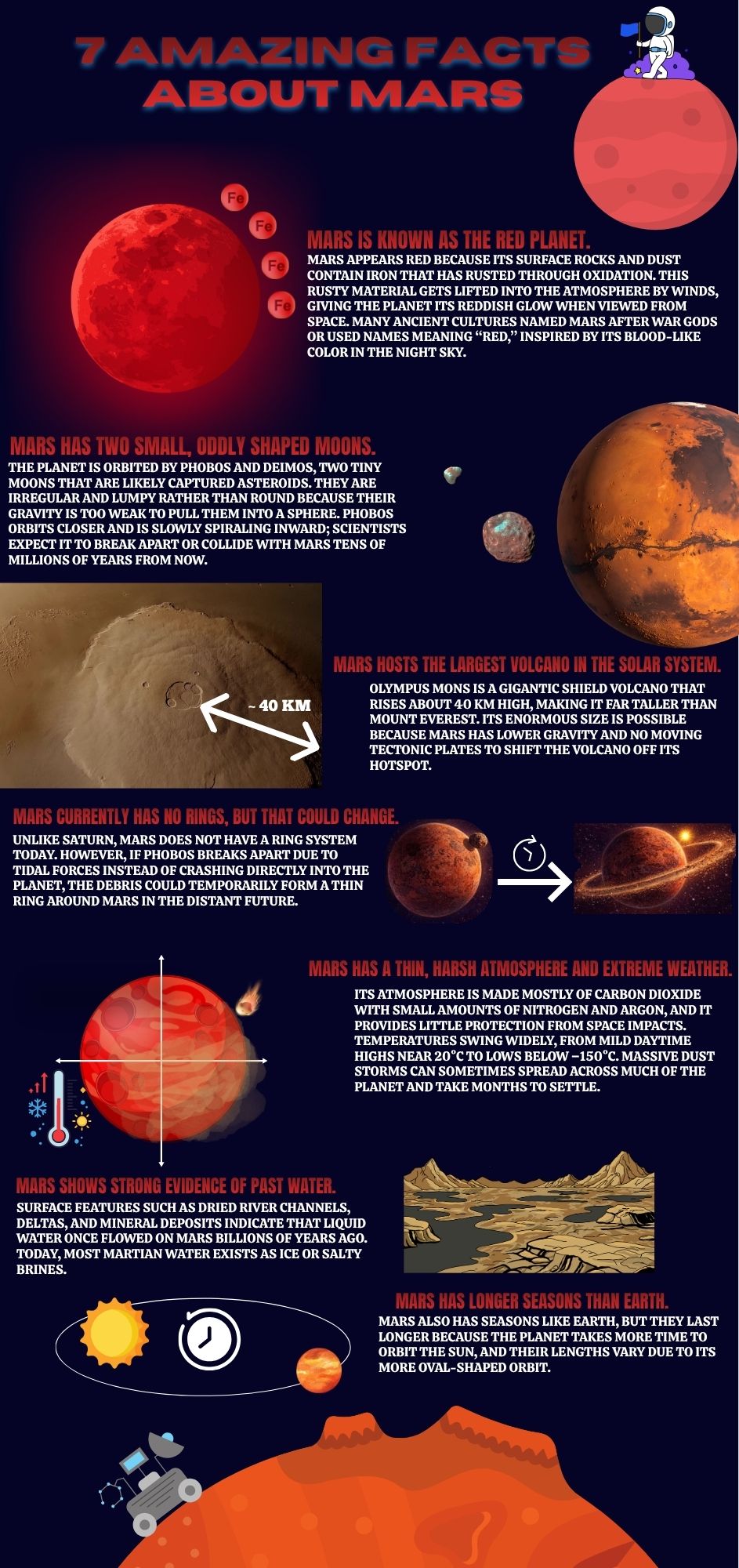
Mars is known as the Red Planet.
Mars appears red because its surface rocks and dust contain iron that has rusted through oxidation. This rusty material gets lifted into the atmosphere by winds, giving the planet its reddish glow when viewed from space. Many ancient cultures named Mars after war gods or used names meaning “red,” inspired by its blood-like color in the night sky.
Mars has two small, oddly shaped moons.
The planet is orbited by Phobos and Deimos, two tiny moons that are likely captured asteroids. They are irregular and lumpy rather than round because their gravity is too weak to pull them into a sphere. Phobos orbits closer and is slowly spiraling inward; scientists expect it to break apart or collide with Mars tens of millions of years from now.
Mars hosts the largest volcano in the solar system.
Olympus Mons is a gigantic shield volcano that rises about 40 km high, making it far taller than Mount Everest. Its enormous size is possible because Mars has lower gravity and no moving tectonic plates to shift the volcano off its hotspot.
Mars currently has no rings, but that could change.
Unlike Saturn, Mars does not have a ring system today. However, if Phobos breaks apart due to tidal forces instead of crashing directly into the planet, the debris could temporarily form a thin ring around Mars in the distant future.
Mars has a thin, harsh atmosphere and extreme weather.
Its atmosphere is made mostly of carbon dioxide with small amounts of nitrogen and argon, and it provides little protection from space impacts. Temperatures swing widely, from mild daytime highs near 20°C to lows below −150°C. Massive dust storms can sometimes spread across much of the planet and take months to settle.
Mars shows strong evidence of past water.
Surface features such as dried river channels, deltas, and mineral deposits indicate that liquid water once flowed on Mars billions of years ago. Today, most Martian water exists as ice or salty brines.
Mars has longer seasons than Earth.
Mars also has seasons like Earth, but they last longer because the planet takes more time to orbit the Sun, and their lengths vary due to its more oval-shaped orbit.