Milky way galaxy
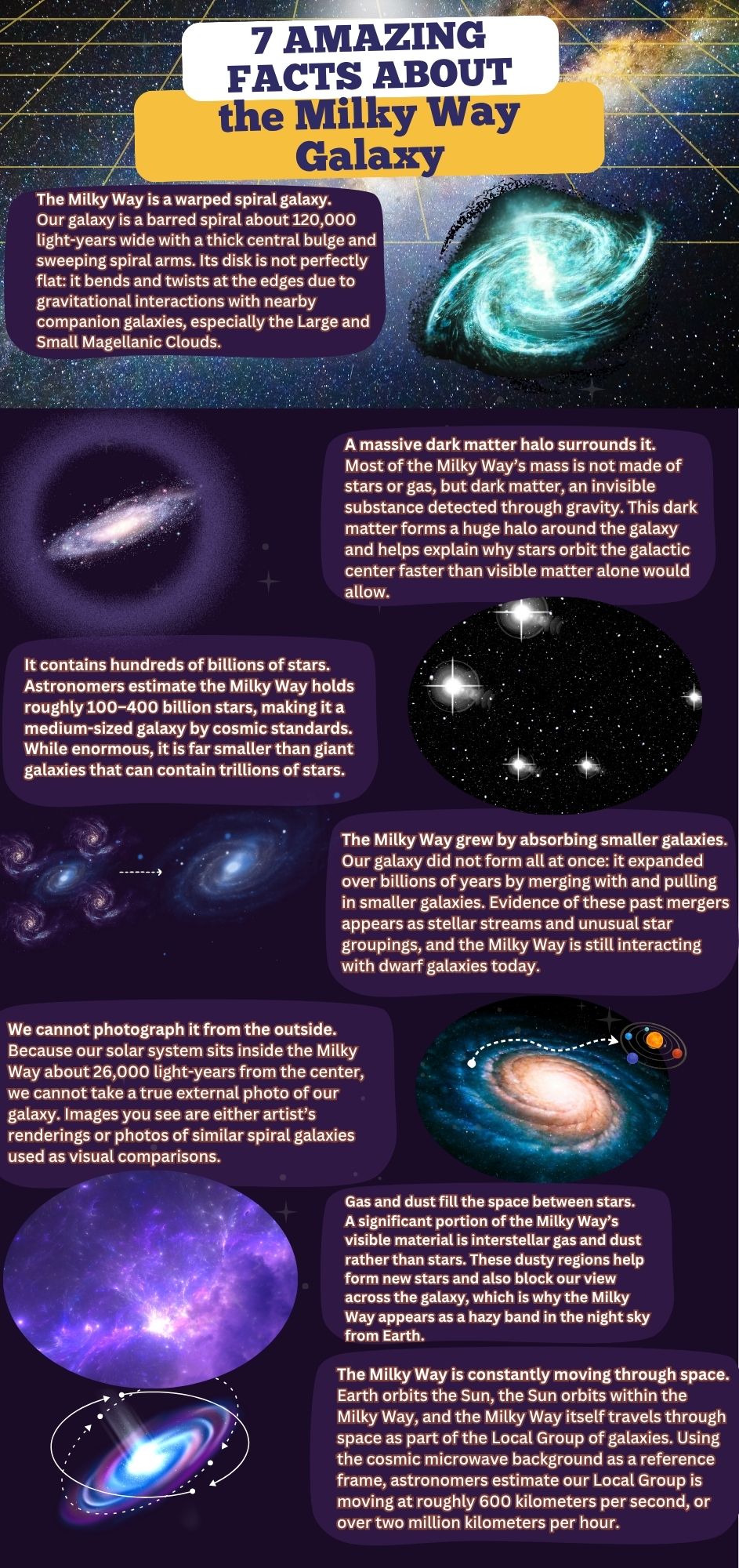
The Milky Way is a warped spiral galaxy.
Our galaxy is a barred spiral about 120,000 light-years wide with a thick central bulge and sweeping spiral arms. Its disk is not perfectly flat: it bends and twists at the edges due to gravitational interactions with nearby companion galaxies, especially the Large and Small Magellanic Clouds.
A massive dark matter halo surrounds it.
Most of the Milky Way’s mass is not made of stars or gas, but dark matter, an invisible substance detected through gravity. This dark matter forms a huge halo around the galaxy and helps explain why stars orbit the galactic center faster than visible matter alone would allow.
It contains hundreds of billions of stars.
Astronomers estimate the Milky Way holds roughly 100–400 billion stars, making it a medium-sized galaxy by cosmic standards. While enormous, it is far smaller than giant galaxies that can contain trillions of stars.
Gas and dust fill the space between stars.
A significant portion of the Milky Way’s visible material is interstellar gas and dust rather than stars. These dusty regions help form new stars and also block our view across the galaxy, which is why the Milky Way appears as a hazy band in the night sky from Earth.
The Milky Way grew by absorbing smaller galaxies.
Our galaxy did not form all at once: it expanded over billions of years by merging with and pulling in smaller galaxies. Evidence of these past mergers appears as stellar streams and unusual star groupings, and the Milky Way is still interacting with dwarf galaxies today.
We cannot photograph it from the outside.
Because our solar system sits inside the Milky Way about 26,000 light-years from the center, we cannot take a true external photo of our galaxy. Images you see are either artist’s renderings or photos of similar spiral galaxies used as visual comparisons.
The Milky Way is constantly moving through space.
Nothing in the universe is stationary, including our galaxy. Earth orbits the Sun, the Sun orbits within the Milky Way, and the Milky Way itself travels through space as part of the Local Group of galaxies. Using the cosmic microwave background as a reference frame, astronomers estimate our Local Group is moving at roughly 600 kilometers per second, or over two million kilometers per hour.