Neutron Stars
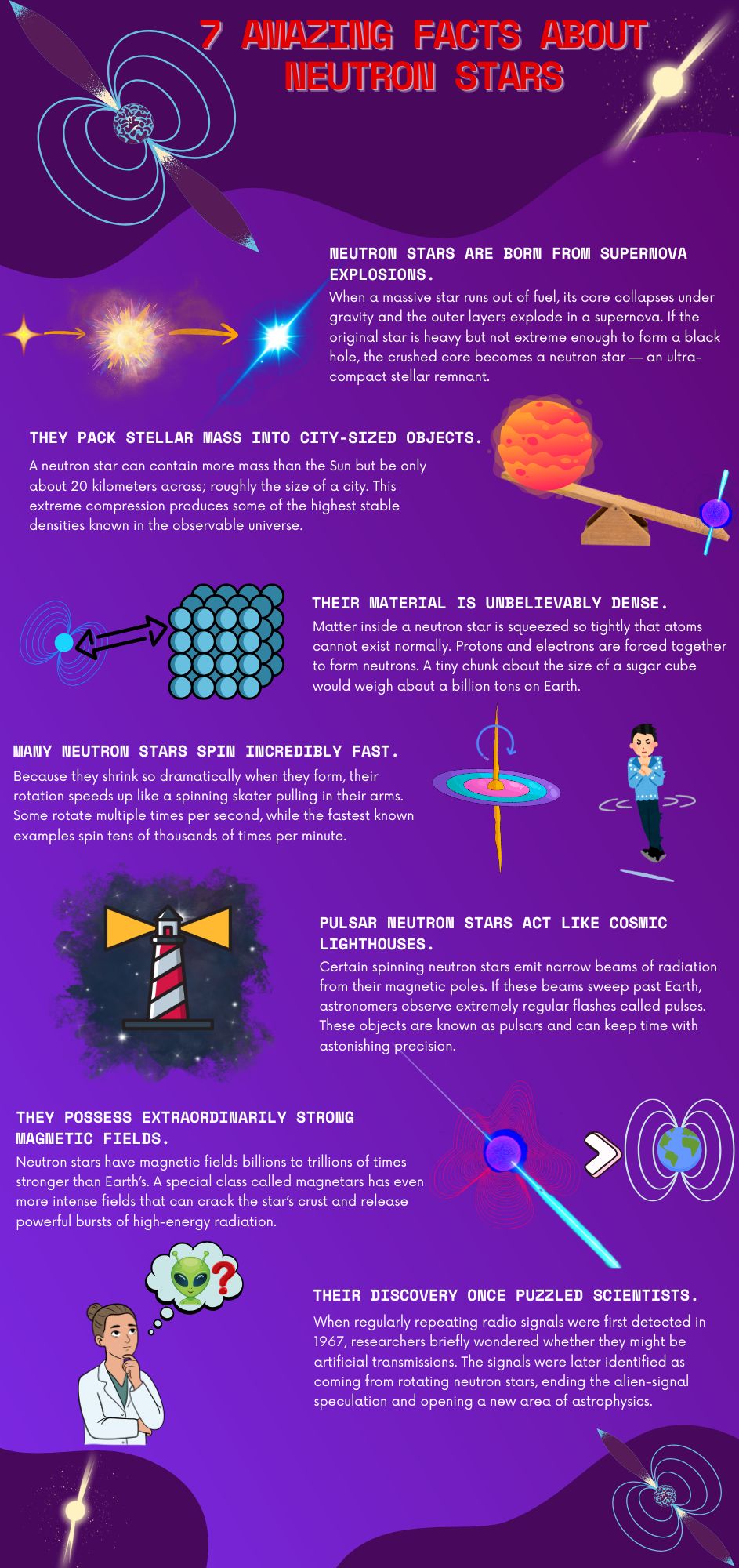
Neutron stars are born from supernova explosions.
When a massive star runs out of fuel, its core collapses under gravity and the outer layers explode in a supernova. If the original star is heavy but not extreme enough to form a black hole, the crushed core becomes a neutron star — an ultra-compact stellar remnant.
They pack stellar mass into city-sized objects.
A neutron star can contain more mass than the Sun but be only about 20 kilometers across; roughly the size of a city. This extreme compression produces some of the highest stable densities known in the observable universe.
Their material is unbelievably dense.
Matter inside a neutron star is squeezed so tightly that atoms cannot exist normally. Protons and electrons are forced together to form neutrons. A tiny chunk the size of a sugar cube would weigh about a billion tons on Earth.
Many neutron stars spin incredibly fast.
Because they shrink so dramatically when they form, their rotation speeds up like a spinning skater pulling in their arms. Some rotate multiple times per second, while the fastest known examples spin tens of thousands of times per minute.
Pulsar neutron stars act like cosmic lighthouses.
Certain spinning neutron stars emit narrow beams of radiation from their magnetic poles. If these beams sweep past Earth, astronomers observe extremely regular flashes called pulses. These objects are known as pulsars and can keep time with astonishing precision.
They possess extraordinarily strong magnetic fields.
Neutron stars have magnetic fields billions to trillions of times stronger than Earth’s. A special class called magnetars has even more intense fields that can crack the star’s crust and release powerful bursts of high-energy radiation.
Their discovery once puzzled scientists.
When regularly repeating radio signals were first detected in 1967, researchers briefly wondered whether they might be artificial transmissions. The signals were later identified as coming from rotating neutron stars, ending the alien-signal speculation and opening a new area of astrophysics.