Saturn
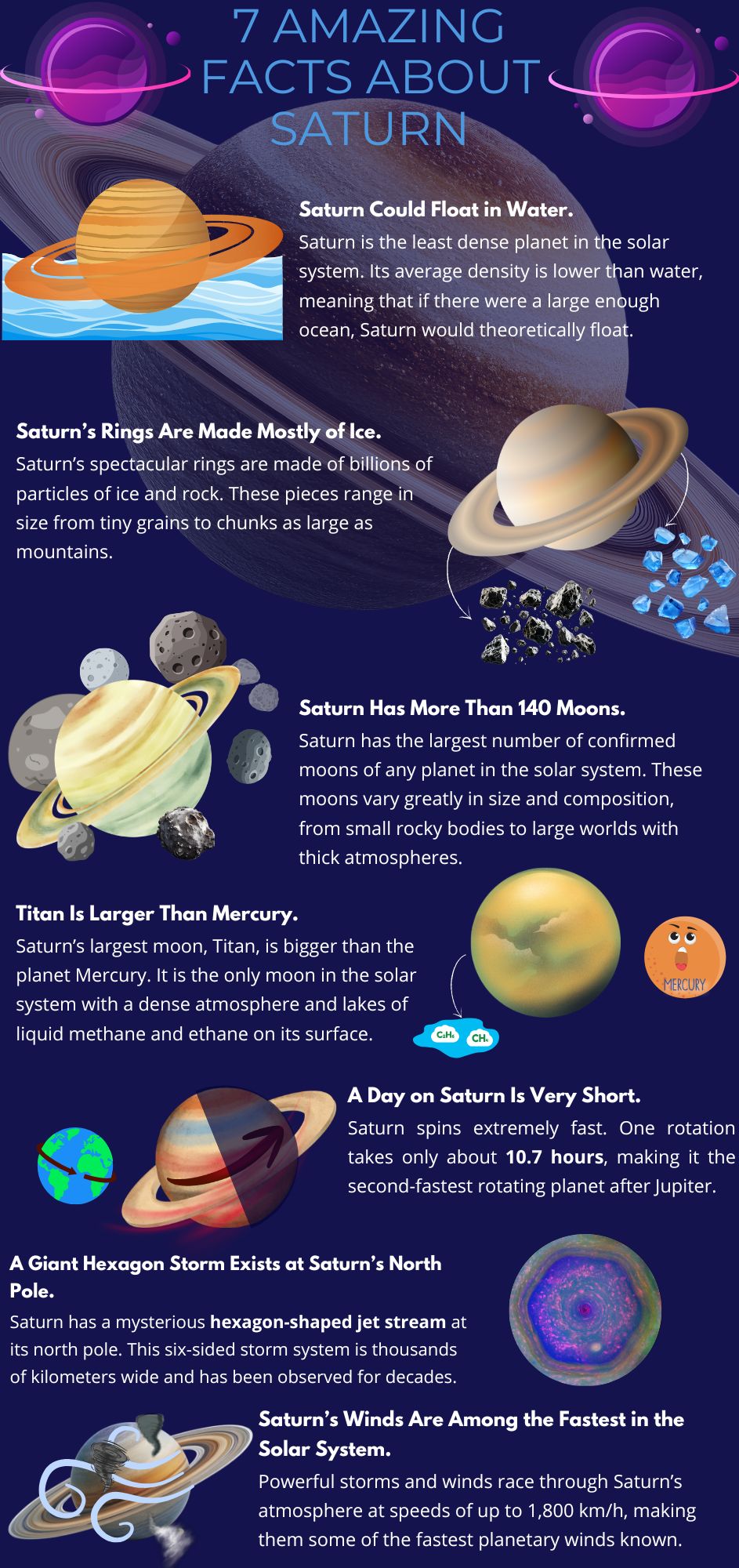
- Saturn Could Float in Water: Saturn is the least dense planet in the solar system. Its average density is lower than water, meaning that if there were a large enough ocean, Saturn would theoretically float.
- Saturn’s Rings Are Made Mostly of Ice: Saturn’s spectacular rings are made of billions of particles of ice and rock. These pieces range in size from tiny grains to chunks as large as mountains.
- Saturn Has More Than 140 Moons: Saturn has the largest number of confirmed moons of any planet in the solar system. These moons vary greatly in size and composition, from small rocky bodies to large worlds with thick atmospheres.
- Titan Is Larger Than Mercury: Saturn’s largest moon, Titan, is bigger than the planet Mercury. It is the only moon in the solar system with a dense atmosphere and lakes of liquid methane and ethane on its surface.
- A Day on Saturn Is Very Short: Saturn spins extremely fast. One rotation takes only about 10.7 hours, making it the second-fastest rotating planet after Jupiter.
- A Giant Hexagon Storm Exists at Saturn’s North Pole: Saturn has a mysterious hexagon-shaped jet stream at its north pole. This six-sided storm system is thousands of kilometers wide and has been observed for decades.
- Saturn’s Winds Are Among the Fastest in the Solar System: Powerful storms and winds race through Saturn’s atmosphere at speeds of up to 1,800 km/h, making them some of the fastest planetary winds known.