7 Interesting Facts About the Sun
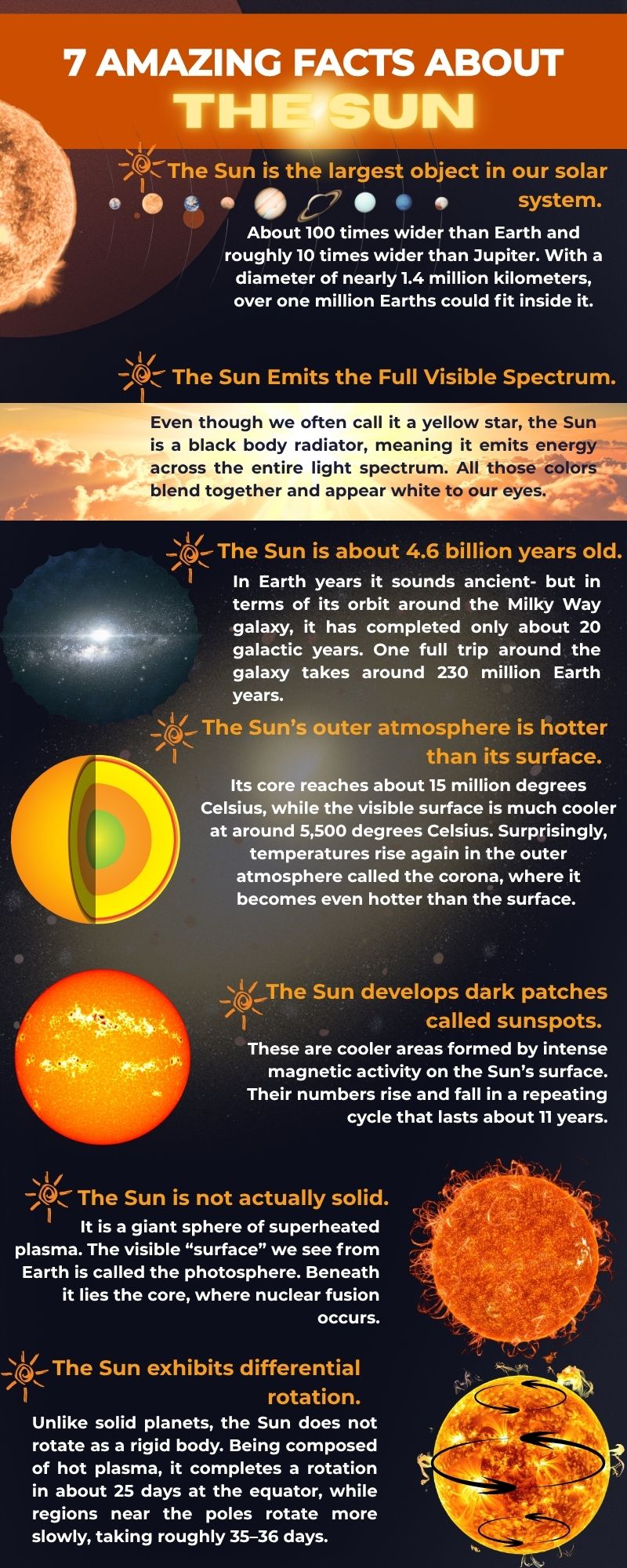
- The Sun is the largest object in our solar system. It is about 100 times wider than Earth and roughly 10 times wider than Jupiter. With a diameter of nearly 1.4 million kilometers, over one million Earths could fit inside it.
- The Sun Emits the Full Visible Spectrum. Even though we often call it a yellow star, the Sun is a black body radiator, meaning it emits energy across the entire light spectrum. All those colors blend together and appear white to our eyes.
- The Sun is about 4.6 billion years old. In Earth years it sounds ancient- but in terms of its orbit around the Milky Way galaxy, it has completed only about 20 galactic years. One full trip around the galaxy takes around 230 million Earth years.
- The Sun’s outer atmosphere is hotter than its surface. Its core reaches about 15 million degrees Celsius, while the visible surface is much cooler at around 5,500 degrees Celsius. Surprisingly, temperatures rise again in the outer atmosphere called the corona, where it becomes even hotter than the surface.
- The Sun develops dark patches called sunspots. These are cooler areas formed by intense magnetic activity on the Sun’s surface. Their numbers rise and fall in a repeating cycle that lasts about 11 years.
- The Sun is not actually solid. It is a giant sphere of superheated plasma. The visible “surface” we see from Earth is called the photosphere. Beneath it lies the core, where nuclear fusion occurs.
- The Sun exhibits differential rotation. Unlike solid planets, the Sun does not rotate as a rigid body. Being composed of hot plasma, it completes a rotation in about 25 days at the equator, while regions near the poles rotate more slowly, taking roughly 35–36 days.