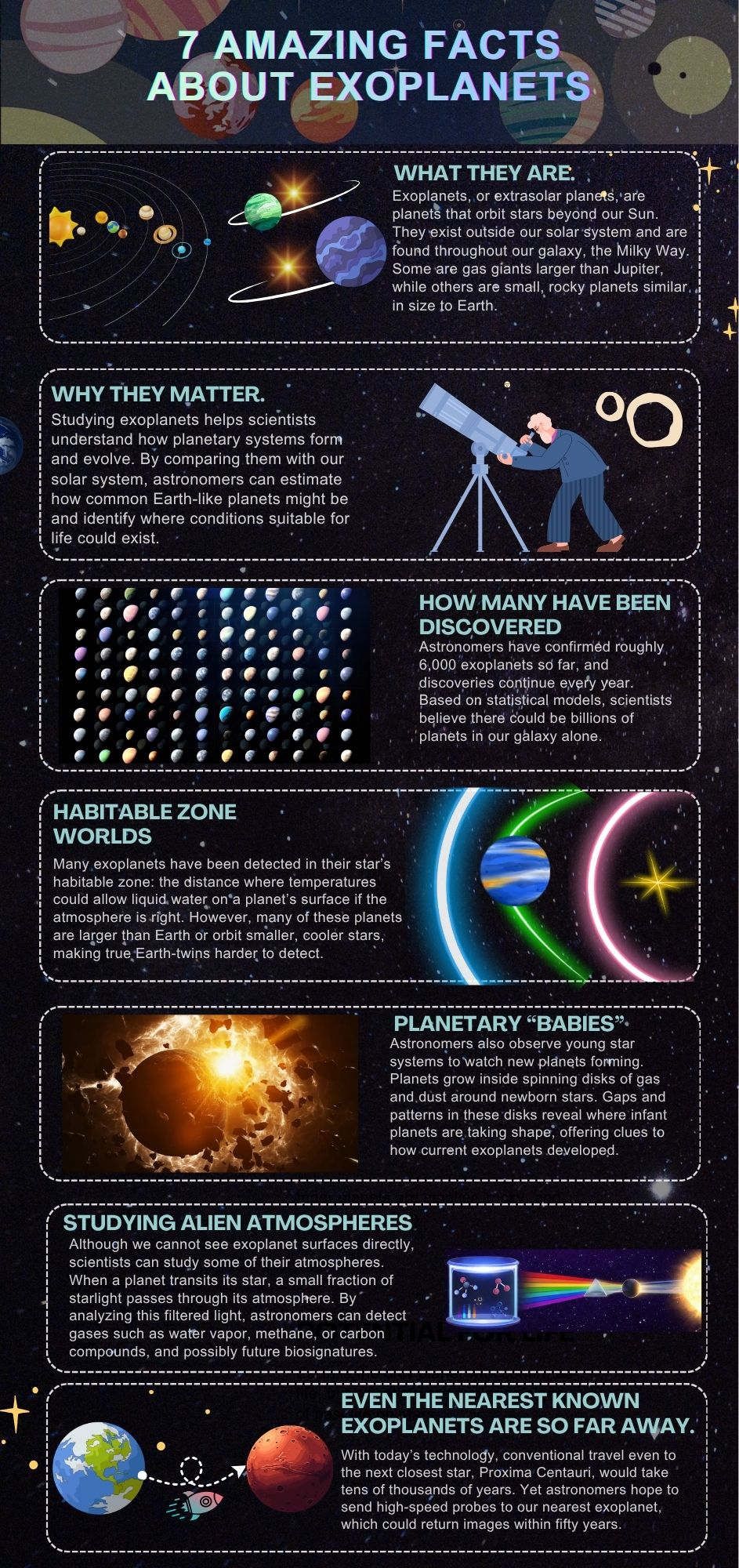
Exoplanets
What They Are.
Exoplanets, or extrasolar planets, are planets that orbit stars beyond our Sun. They exist outside our solar system and are found throughout our galaxy, the Milky Way. Some are gas giants larger than Jupiter, while others are small, rocky planets similar in size to Earth.
Why They Matter.
Studying exoplanets helps scientists understand how planetary systems form and evolve. By comparing them with our solar system, astronomers can estimate how common Earth-like planets might be and identify where conditions suitable for life could exist.
How Many Have Been Discovered
Astronomers have confirmed roughly 6,000 exoplanets so far, and discoveries continue every year. Based on statistical models, scientists believe there could be billions of planets in our galaxy alone.
Habitable Zone Worlds
Many exoplanets have been detected in their star’s habitable zone: the distance where temperatures could allow liquid water on a planet’s surface if the atmosphere is right. However, many of these planets are larger than Earth or orbit smaller, cooler stars, making true Earth-twins harder to detect.
Planetary “Babies”
Astronomers also observe young star systems to watch planets forming. New planets grow inside spinning disks of gas and dust around newborn stars. Gaps and patterns in these disks reveal where infant planets are taking shape, offering clues to how current exoplanets developed.
Studying Alien Atmospheres
Although we cannot see exoplanet surfaces directly, scientists can study some of their atmospheres. When a planet transits its star, a small fraction of starlight passes through its atmosphere. By analysing this filtered light, astronomers can detect gases such as water vapour, methane, or carbon compounds, and possibly future biosignatures.
Even the nearest known exoplanets are so far away.
With today’s technology, conventional travel even to the next closest star, Proxima Centauri, would take tens of thousands of years. Yet astronomers hope to send high-speed probes to our nearest exoplanet, which could return images within fifty years.